





Getting high traffic but low sales is one of the most frustrating problems in marketing. Your website traffic keeps climbing. Web traffic reports look healthy. But conversions stay flat, and revenue refuses to follow.
This usually leads teams to the wrong conclusion: we need more traffic.
In reality, when a funnel gets traffic but no sales, the issue is almost never volume. It’s alignment. It’s friction. It’s a breakdown somewhere between initial interest and the payment page.
This guide explains how to fix a funnel that gets traffic but no sales using simple language, real-world logic, and proven conversion optimization principles. Whether you run an ecommerce store, an online store, or a service-based business, the fundamentals are the same.
Why Traffic Alone Doesn’t Generate Sales
High traffic with a low conversion rate is a warning sign. It means a significant factor in your marketing funnel is broken.
Your visitors may not be the right target audience. Your value proposition may be unclear. Or your sales funnel may be leaking customers at key moments in the customer journey.
Online shoppers don’t lack options. If anything feels confusing, slow, or untrustworthy, they leave. That’s how lost sales happen.
Before you try to attract customers with more ad campaigns or search engine optimization (SEO), you need to fix what happens after they arrive.
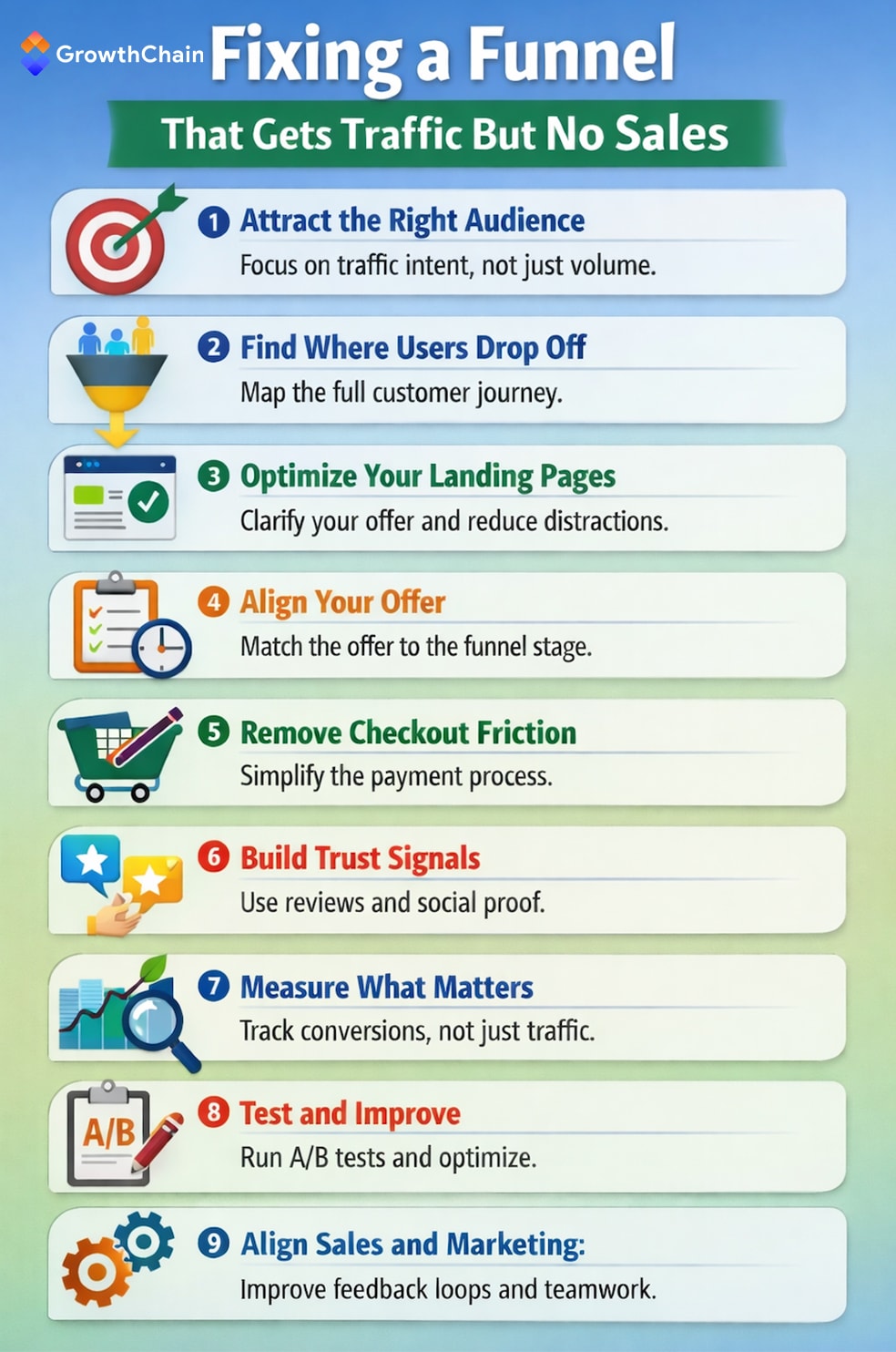
Step One: Make Sure You’re Attracting Your Target Audience

The fastest way to create low conversion is to attract the wrong audience.
A lot of website traffic comes from search engines, Google Ads, or social media posts that generate clicks but not buyers. This usually means intent is wrong.
Someone searching for education wants valuable insights. Someone searching for pricing or comparisons wants to buy. Mixing these up kills conversion success.
Good market research helps here. So do detailed buyer personas. You need to understand customer behavior before the click, not just after.
If your traffic doesn’t match purchase intent, no amount of conversion optimization will fix it.
Step Two: Understand Where Users Drop Off
Every funnel has friction points. Most teams just don’t look for them.
Instead of obsessing over total traffic, focus on how users move through your conversion funnel. Look at landing pages, product pages, the checkout page, and the payment process.
Session recordings and analytics tools can reveal patterns quickly. You’ll often see users hesitate, scroll, rage-click, or abandon pages entirely.
These behaviors usually point to confusion, missing trust signals, or unexpected costs.
A funnel that leaks at one stage will never generate sales consistently.
Step Three: Fix Landing Pages Before Anything Else

Landing pages are where conversion either starts or dies.
A strong landing page makes three things immediately clear: who it’s for, what problem it solves, and why it’s better. This is your unique selling proposition.
Too many landing pages try to do everything at once. Too many pop ups, too many CTAs, too much noise. This overwhelms users, especially on mobile devices.
High quality images, clear product descriptions, and simple language matter more than clever copy.
If users don’t understand the value in five seconds, they won’t convert.
Step Four: Match the Offer to the Moment
One of the biggest reasons funnels fail is timing.
Not every visitor is ready for an initial sale. Some need reassurance. Others need proof. Others just need clarity.
Trying to force a purchase too early pushes potential customers away. This is where nurturing matters.
Good funnels encourage customers gradually. They offer value first, then guide users forward through the sales process.
Email flows, retargeting, and content all help nurture leads — but only if they match where the customer engagement actually is.
Step Five: Remove Friction From the Checkout
The checkout page is where most lost sales happen.
Unexpected costs, limited payment options, slow website speed, or a confusing payment page will destroy conversion rates instantly.
Customers prefer flexibility. Guest checkout options matter. So does a smooth payment process across devices.
Broken links, errors, or slow load times turn interested buyers into bounce traffic.
If you sell online, this part of the funnel deserves obsessive attention.
Step Six: Build Trust at Every Step

People don’t buy when they don’t trust.
Trust signals include social proof, positive reviews, user generated content, and clear policies. These aren’t optional. They are conversion drivers.
Satisfied customers sell for you. Real testimonials outperform polished marketing copy every time.
Customer satisfaction isn’t just a post-sale metric. It directly affects potential sales and future sales.
If trust is missing, conversions will stall no matter how strong your traffic is.
Step Seven: Measure What Actually Matters
Traffic is a vanity metric. Conversion success is not.
Track conversions properly. Look at conversion rate by channel, device, and page. Understand how user engagement changes throughout the funnel.
A low conversion rate with high traffic tells you exactly where to look — if you’re paying attention.
This is where marketing effectiveness improves. Not by guessing, but by learning from customer behavior.
Step Eight: Test, Don’t Guess

Conversion optimization is a process, not a one-time fix.
A/B testing helps validate ideas, but only when it’s focused. Test one thing at a time. Headlines. CTAs. Layout. Payment options.
B testing without a hypothesis wastes time. Use data, session recordings, and real user behavior to guide decisions.
Small improvements compound into more conversions over time.
Step Nine: Align Sales and Marketing
Many funnels fail because the sales and marketing team operate in silos.
Marketing attracts traffic. Sales handle objections. When these teams don’t talk, the funnel breaks.
Shared feedback loops improve marketing strategy, messaging, and targeting. This alignment increases conversion success and creates repeat customers.
Growth happens when teams work on the same funnel, not separate goals.
Final Thought: You Don’t Need More Traffic
If your funnel gets traffic but no sales, the answer isn’t more visitors.
It’s clarity. Trust. Speed. Alignment.
Fix those, and your existing traffic will generate sales, increase conversions, and unlock growth you already paid for.

From The Blog
You may also like


Stop Guessing. Start Scaling.
Data-driven crypto marketing that actually delivers users, not vanity metrics.

GrowthChain is a disruptive web3 marketing agency looking to propel your customer base. We focus on DAOs, DeFi, NFT and Crypto projects.

GrowthChain Designed, 2025
.svg)