






There's a version of a crypto launch that plays out over and over. The product is solid, the team has been building for months, the token is ready. Launch day arrives, there's a spike of attention, and then a week later the chart flattens and the Discord goes quiet. The build was never the problem. The go-to-market was.
A crypto go-to-market strategy is the plan for how a project enters the market and wins its first users. It's distinct from your ongoing marketing strategy, which is about sustaining growth once you're established. Go-to-market is the launch motion itself: how you position the project, who you target first, how you build distribution before you have anything to sell, and how you turn launch day into the start of something rather than the peak.
This guide walks through how to build a strong GTM strategy for a crypto project, component by component. For the broader picture of how marketing works once you're live, our ultimate crypto marketing strategy guide covers the ongoing side; this article is about getting to market in the first place.
What Is a Crypto Go-to-Market Strategy?
A crypto go-to-market strategy defines how a blockchain project launches into a new market: how it reaches potential customers, communicates its value proposition, and acquires its first users. Launching a cryptocurrency requires both traditional tech go-to-market tactics and crypto-native community building, which is what makes a crypto GTM strategy its own discipline rather than a copy of a standard SaaS playbook.
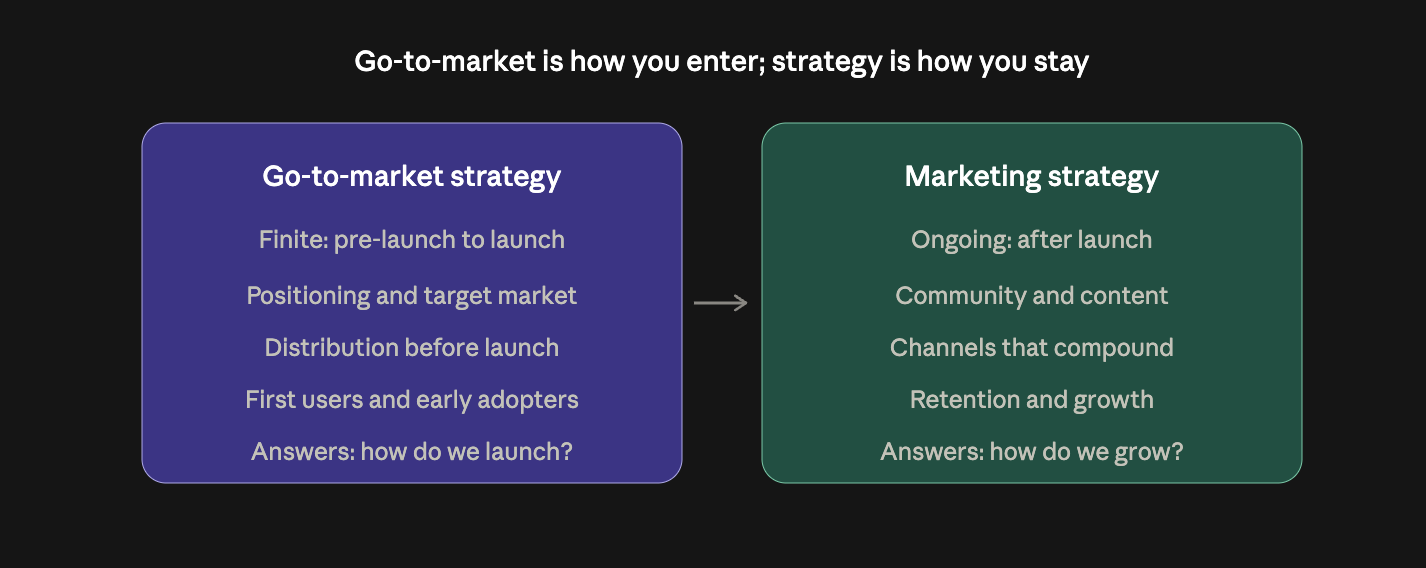
The distinction matters because the two get conflated constantly. Your go-to-market strategy is finite. It runs from pre-launch through launch and answers a single question: how do we enter the market and get our first users? Your marketing strategy is ongoing and answers a different question: how do we keep growing? Confusing the two is how projects end up with a launch plan that has no life after launch day, or a marketing plan that never actually gets the project off the ground.
A successful GTM strategy rests on genuine product utility. Trust and decentralization dictate success in the cryptocurrency space, and no amount of marketing effort will carry a product that doesn't do something people actually want. The GTM plan amplifies real value; it can't manufacture it.
The Components of a Crypto GTM Strategy
Before getting into the sequence, it helps to see the whole picture. A comprehensive plan has seven components, and each one feeds the next.
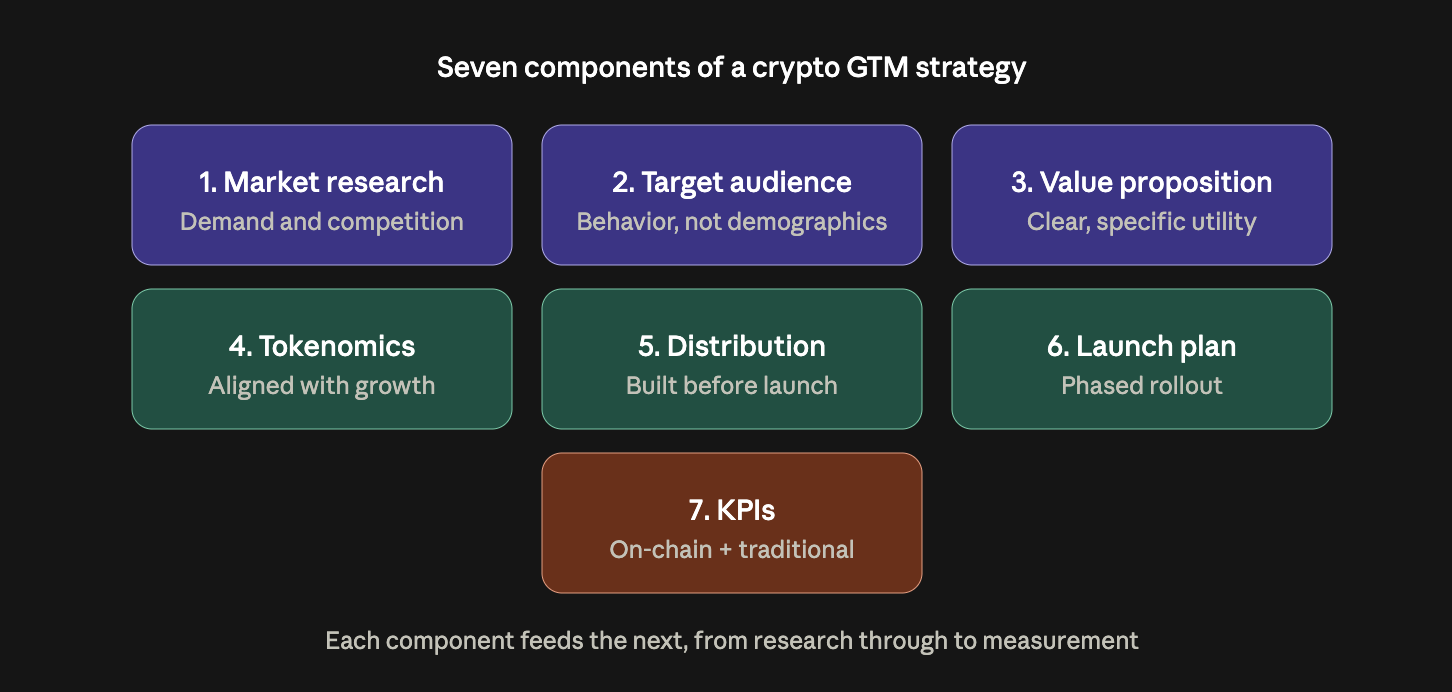
Market research tells you whether there's demand and who else is competing for it. Your target audience narrows that market to the specific people you'll win first. Your value proposition defines what you offer them and why it's different. Tokenomics aligns your economic model with long-term growth. Distribution is how you reach people, built before launch rather than after. Your launch plan sequences the rollout. And your key performance indicators (KPIs) tell you whether any of it worked. Skip one and the others weaken; the plan only holds together as a whole.
Start With Market Research and Analysis
Every strong GTM strategy starts with a deep understanding of the market you're entering. Market research and market analysis aren't box-ticking exercises; they're what stop you building a launch around assumptions that turn out to be wrong.
Good market intelligence answers a few concrete questions. Is there real demand for what you're building, or are you creating a solution looking for a problem? What are the market conditions right now, and are they favourable for the kind of launch you're planning? Where are the gaps that existing options have left open?
Competitive analysis is part of this, but the goal isn't to copy what works elsewhere. It's to find the position nobody else occupies. The clearer your read on the market, the sharper every downstream decision becomes, from your positioning to your channel strategy. Customer analysis and early customer insights gathered here will shape the entire plan, so it's worth doing properly before anything else.
Define Your Target Audience by Behavior
Once you understand the market, you narrow it. The single most common mistake in crypto go-to-market is trying to launch to everyone at once. A product for everyone reaches no one.
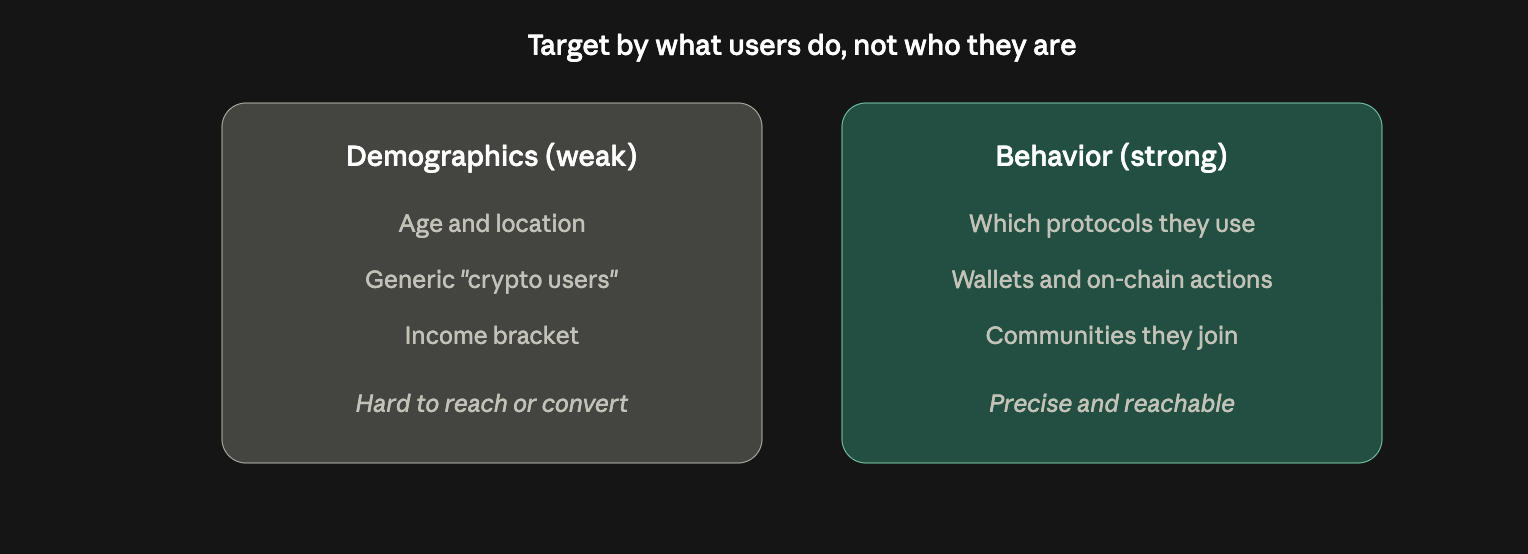
Target audience definition in crypto should focus on behavior, not demographics. Age, location, and income bracket tell you almost nothing about whether someone will use a DeFi protocol or hold a governance token. What they already do tells you everything. Which protocols do they interact with? What's in their wallet? Which communities do they participate in? Behavioral targeting gives you a target customer you can actually find and reach, rather than a vague demographic you can only guess at.
The narrower and more specific your target segments, the easier every other decision becomes. A precise target market shapes your value proposition, your marketing channels, and your entire distribution plan. Defining whether your product serves developers or retail users, for instance, changes almost everything downstream: developers need documentation and incentives to build, while retail users need education and a smooth customer experience. You can't serve both well with a single undifferentiated launch.
Build a Clear Value Proposition
With the audience defined, you can articulate why they should care. A clear value proposition is the sentence that explains what your project does and why it's meaningfully better than the alternatives your target audience is already using.
In crypto, this is harder than it sounds, because so many projects describe themselves in near-identical language. Positioning statements that could apply to a hundred other projects don't position anything. The value proposition has to be specific enough that someone in your target market immediately understands what they'd get and why it matters to them.
Developing a clear narrative is part of this. The narrative is how you explain the product and its value proposition in a way people remember and repeat. Auditing and security are worth surfacing here too, since in crypto they function as trust signals as much as technical features; a project that leads with its security posture is speaking directly to a market that has learned to be cautious.
Design Tokenomics That Align With Growth
If your project has a token, its economic design is part of the go-to-market strategy, not a separate concern to hand off to the tokenomics team.
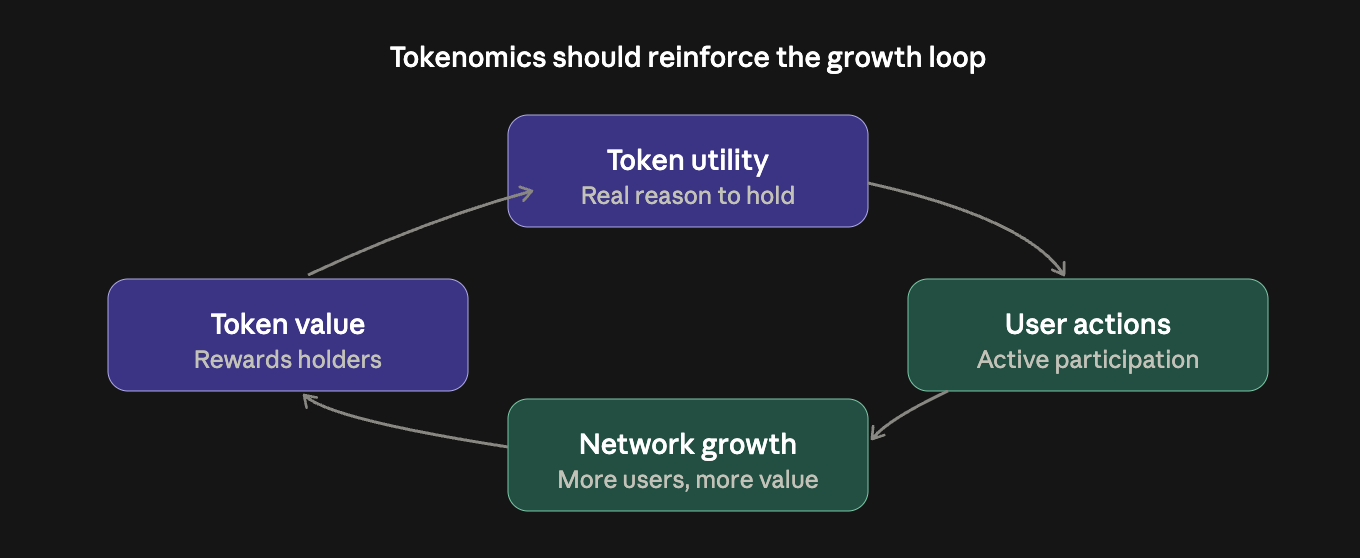
The principle that separates sustainable launches from short-lived ones is simple: design tokenomics around product behavior, aligning token utility with the product's growth loop. When the token gives users a real reason to participate, that participation drives network growth, network growth increases the token's value, and rising value rewards the users who showed up. The loop reinforces itself.
The failure mode is tokenomics built to attract short-term capital rather than long-term users. Designs that reward speculation over participation pull in money that leaves the moment incentives dry up, often triggering the sell-offs that kill momentum right when a project needs it most. Sustainable tokenomics aligns incentives so that the people holding the token are the people using the product. Get this alignment right and the token becomes a growth engine; get it wrong and it becomes a liability that undermines the whole launch.
Build Distribution Channels Before You Launch
Here's the principle that most separates projects that launch well from those that don't: building distribution before launch is the key to a successful token or protocol. Distribution isn't something you switch on at launch. It's something you build in the months before, so that when launch day comes, there's already an audience ready to act.
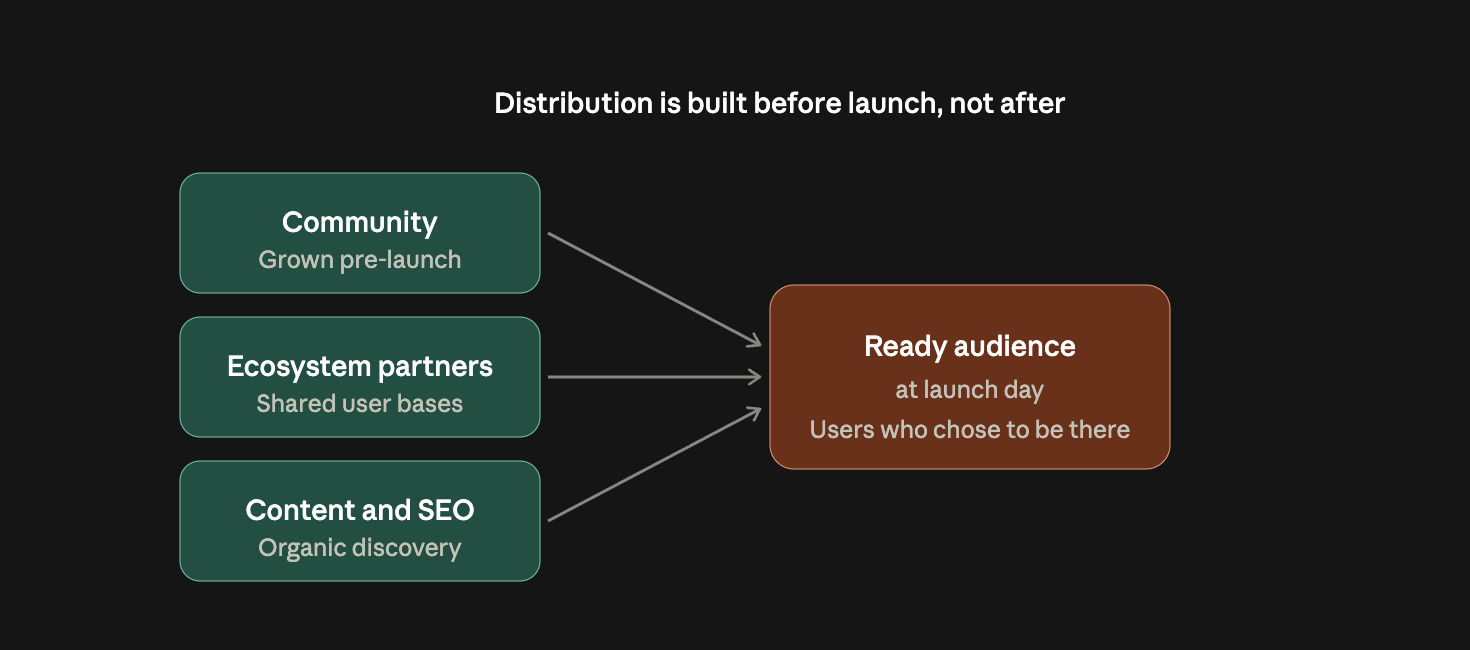
Effective go-to-market strategies in crypto rely on three distribution levers, and all three should be in motion well before launch. Community building comes first, because community driven growth before launch produces early adopters who chose to be there rather than users who were paid to appear. Strategic ecosystem partnerships come second: integrating with established protocols leverages shared liquidity and exposes your product to active user bases you'd otherwise have to build from scratch. These strategic partnerships bootstrap both distribution and credibility at once. Content marketing and crypto SEO come third, creating the organic discovery paths that keep bringing in new users long after launch.
The projects that build these channels early arrive at launch day with a ready audience. The ones that don't spend launch day trying to build distribution from a standing start, which almost never works. Distribution built in advance is what turns a launch from a single spike into the beginning of sustained user growth.
Sequence Your Launch in Phases
With distribution in place, the launch itself should be sequenced rather than fired off in a single moment. A phased rollout de-risks the whole thing.
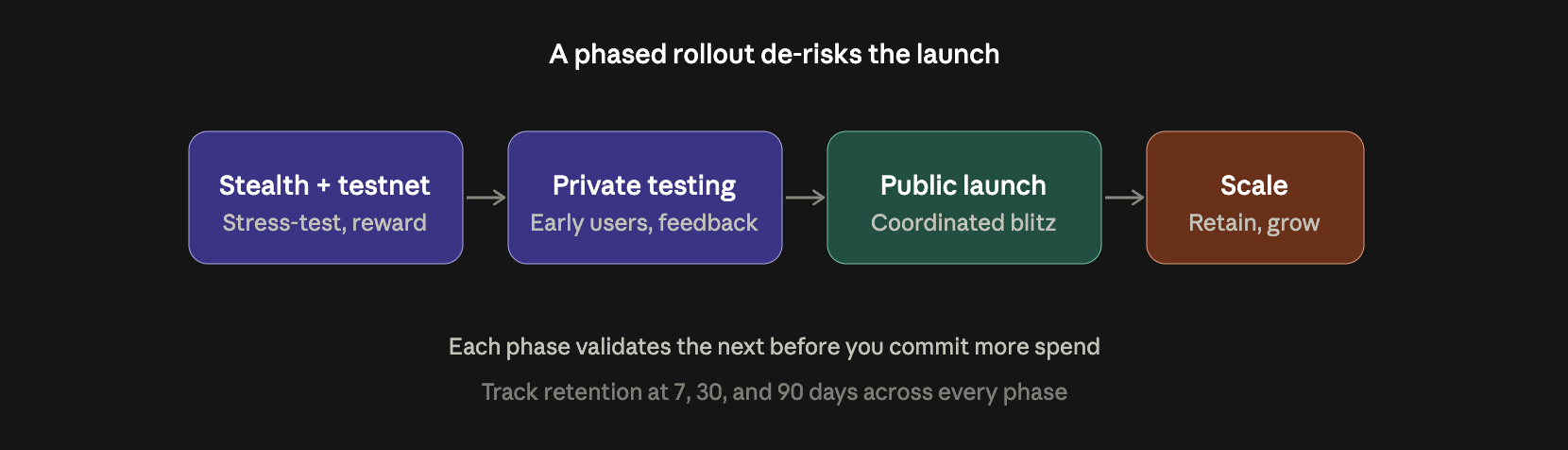
A structured launch plan moves through distinct phases. Stealth mode and testnet come first, letting you stress-test infrastructure and reward early users before anything is public. Private testing follows, bringing in a controlled group of early users whose feedback sharpens the product and whose participation seeds early adoption. The public launch is where a coordinated blitz creates immediate buzz and momentum, but only because the groundwork underneath it is already solid. Then comes the scale phase, where the focus shifts to retention and growth.
Each phase validates the next before you commit more resources. A launch that stress-tests quietly, gathers real feedback from early users, and only then goes loud is far more likely to hold together than one that goes straight to a public splash and hopes the infrastructure survives contact with real demand.
Regulatory strategy runs through all of this. Mitigating legal risk with a compliance roadmap integrated into the GTM plan, rather than bolted on afterward, is what keeps a promising launch from becoming a legal problem. Compliance is easiest when it's designed in from the start.
Define Your Success Metrics
A go-to-market strategy you can't measure is a go-to-market strategy you can't improve. The final component is defining, before launch, what success actually looks like.
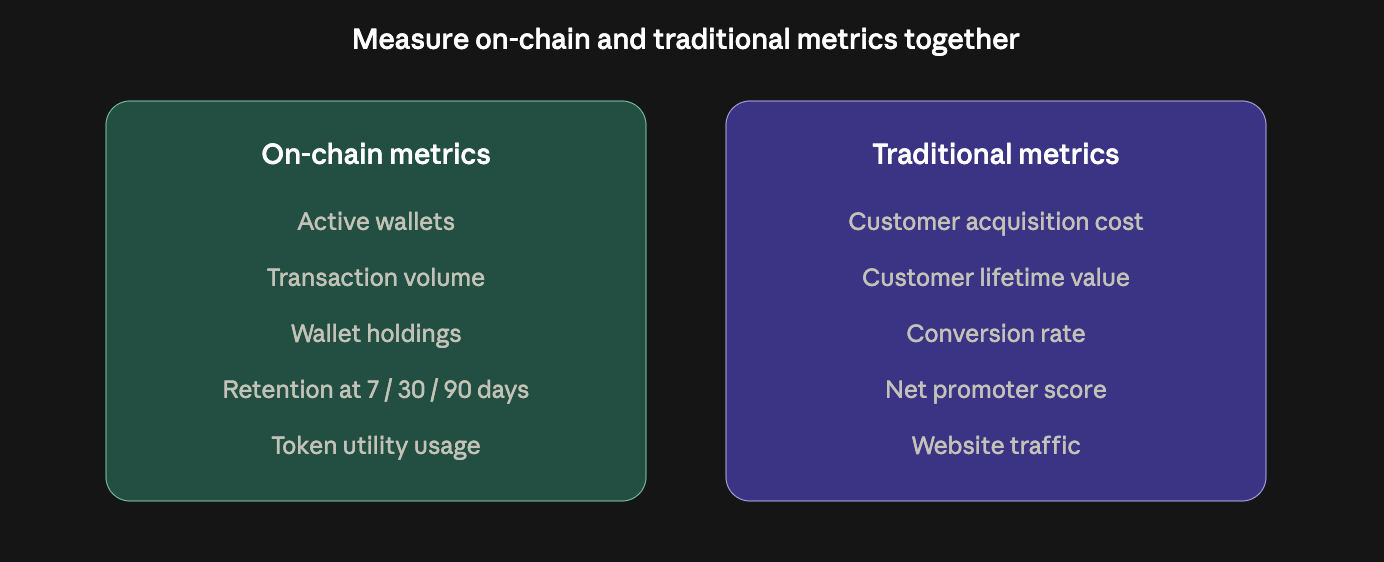
The most accurate picture comes from measuring on-chain and traditional metrics together. On-chain data tells you what's really happening: active wallets, transaction volume, wallet holdings, and retention tracked at 7, 30, and 90 days post-launch. These key metrics reveal genuine engagement rather than surface activity. Traditional success metrics fill in the rest of the picture: customer acquisition cost, customer lifetime value, conversion rate, net promoter score, and website traffic all connect your marketing efforts to business objectives.
Combining data across both sets is how you identify your high-value user groups and set realistic performance benchmarks. Predictive analytics built on early data can tell you which user segments are worth doubling down on and which channels are delivering real customer acquisition rather than vanity numbers. The projects that measure this way improve their GTM in real time; the ones that only watch follower counts and token price are flying blind.
Bringing the Strategy Together
A crypto go-to-market strategy is a sequence, and the order matters. Research the market, narrow to a behavioral target audience, sharpen your value proposition, align your tokenomics with growth, build distribution before you launch, sequence the rollout in phases, and measure with both on-chain and traditional metrics from day one. Each key element depends on the ones before it.
The projects that get this right rarely have the biggest budgets. They have the clearest sequence. They build distribution while others are still designing their logo, they target a specific audience while others chase everyone, and they arrive at launch with an audience already waiting rather than an announcement into an empty room.
Getting a crypto go-to-market strategy right is difficult, and the cost of getting it wrong is a launch that spikes and fades. At GrowthChain, we help crypto projects plan and execute go-to-market strategies that turn launch day into lasting momentum, from positioning and distribution through to measurement. If you're preparing to launch a token or protocol and want a GTM plan built on what actually works in 2026, get in touch with our team and let's build it together.
Frequently Asked Questions
What is a crypto go-to-market strategy?
A crypto go-to-market strategy is the plan for how a blockchain project launches into the market: how it positions itself, defines its target audience, builds distribution, sequences its launch, and acquires its first users. It combines traditional go-to-market tactics with crypto-native community building.
What are the steps in a crypto GTM strategy?
The core steps are market research, defining your target audience by behavior, building a clear value proposition, designing aligned tokenomics, building distribution before launch, sequencing a phased rollout, and defining success metrics across both on-chain and traditional data.
How is a go-to-market strategy different from a marketing strategy?
A go-to-market strategy is finite and focused on market entry, running from pre-launch through launch to answer "how do we get our first users?" A marketing strategy is ongoing and focused on sustaining growth after launch.
Why is building distribution before launch so important?
Distribution built in advance means you arrive at launch day with an audience ready to act, rather than trying to build reach from a standing start. Community, ecosystem partnerships, and content all take time to develop, so starting them early is what makes a launch land.
How should crypto projects define their target audience?
Define the audience by behavior rather than demographics. What protocols people use, what's in their wallets, and which communities they join are far more useful for targeting than age, location, or income.
What metrics measure go-to-market success in crypto?
Combine on-chain metrics like active wallets, transaction volume, and retention at 7, 30, and 90 days with traditional metrics like customer acquisition cost, lifetime value, conversion rate, and net promoter score.

From The Blog
You may also like


Stop Guessing. Start Scaling.
Data-driven crypto marketing that actually delivers users, not vanity metrics.

GrowthChain is a disruptive web3 marketing agency looking to propel your customer base. We focus on DAOs, DeFi, NFT and Crypto projects.

GrowthChain Designed, 2025
.svg)