






Most crypto projects approach marketing the same way. They launch, they post, they pay an influencer or two, and then they wonder why nothing is working. The issue isn't budget. It isn't timing. It's that there's no real strategy underneath any of it.
A crypto marketing strategy isn't just a content calendar or a Twitter plan. It's a structured, data-driven approach to building demand for your project across multiple channels simultaneously, with each one reinforcing the others. When done right, it creates compounding returns. When done wrong, it burns money on short-term hype that evaporates before you've built anything real.
This guide covers everything that goes into an effective crypto marketing strategy in 2026: from narrative positioning to community building, content marketing and SEO to influencer campaigns, generative engine optimization to budget allocation.
Why Crypto Marketing Differs From Traditional Marketing
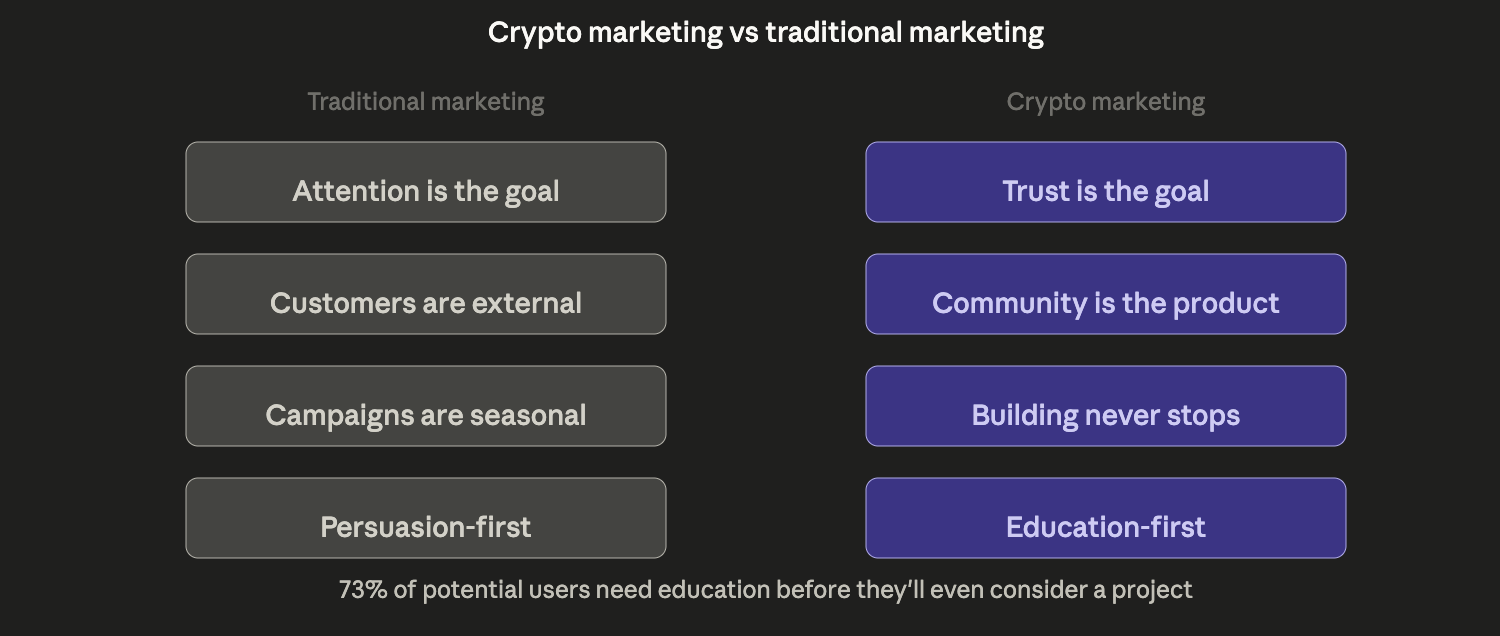
Before getting into tactics, it's worth understanding why crypto marketing differs so significantly from what works in traditional marketing.
The trust gap
Trust is the central variable. Since 2021, consumers have lost over $1 billion to crypto fraud, and 46% of scams start on social media. That's the environment your project is operating in. Potential users arrive skeptical by default, and your marketing efforts either address that skepticism or make it worse. Traditional marketing is mostly about attention and persuasion. Crypto marketing is mostly about trust and education.
Community is infrastructure
In traditional industries, a marketing department markets to customers. In the crypto industry, the community is part of the product. Community members often become advocates, validators, and in many cases governance participants in the project itself. Engaged communities drive project success in ways that no advertising campaign can replicate.
The regulatory layer
The regulatory environment adds complexity that most digital marketing doesn't have to contend with. What you say in a campaign, how you say it, and where you run it all carry compliance implications. Regulatory compliance isn't a legal checkbox; it's a core part of your marketing strategy.
Build Your Narrative First
Every effective crypto marketing strategy starts in the same place: a clear story about what the project does, who it's for, and why it matters now.
A strong brand identity differentiates crypto projects in a competitive crypto market where hundreds of new protocols, tokens, and platforms launch every month. Consistent branding builds trust with the audience over time, but it can only do that if there's something coherent and specific to be consistent about.
The three components of your positioning
Your narrative has three components. Your value proposition answers what problem you solve and why your solution is meaningfully better than alternatives. Your target audience defines exactly who you're building for, not a vague demographic but a specific type of person with a specific problem your project solves. And your positioning establishes where you sit in the market and what makes you different.
Why narrative comes before everything else
Clear positioning matters more in crypto than almost any other market because audiences have seen enough hype to know when something is empty. Blatant promotion without substance is immediately recognised and dismissed. Crypto audiences are sophisticated, and they respond to honest, specific claims backed by evidence.
Get this part right before spending on anything else. Every marketing channel, every campaign, every piece of content flows downstream from the narrative. If the narrative is vague or generic, nothing you build on top of it will perform.
Community Building Is Your Highest-Leverage Channel
For most crypto projects, community building is where the majority of early marketing resources should go. Successful projects mix financial incentives with real relationships among community members, and building a genuine crypto community requires consistent effort before organic momentum becomes self-sustaining.
Depth over size
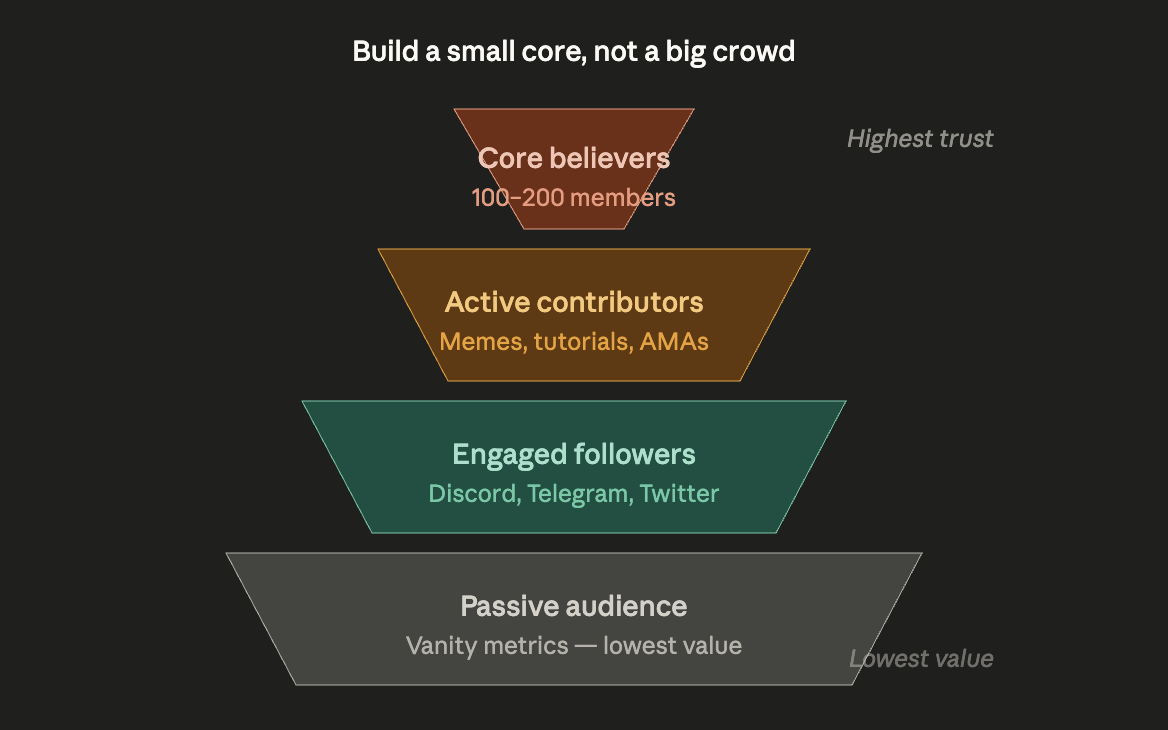
The most important principle in community building is prioritising depth over size. A token with 50 genuinely engaged and aligned community members communicates more credibility to the market than one with 50,000 passive followers. A large, inactive community is a negative signal. It suggests the project bought growth without building something people actually care about.
The role of active participation
What you say matters less than how often you show up. Founders who personally answer questions in Discord and Telegram build trust significantly faster than projects that delegate everything to community managers. Personal brands create more engagement than faceless corporate logos, and in the crypto space, people invest in people as much as they invest in projects.
Active participation means high-context discussions, not just moderation. Running AMAs regularly creates real dialogue and converts lurkers into active members. User-generated content, whether memes, tutorials, or reviews, extends your reach while making the community feel like co-builders rather than spectators.
Community-oriented growth tools
A few practical mechanisms that create genuine community engagement:
Governance voting gives members a stake in the project's direction. Referral programs that offer bonus tokens or exclusive access encourage new users to bring in others they trust. Token quests and rewards tied to meaningful actions, such as product testing or content creation, build participation that goes beyond passive membership.
Community-driven growth models are increasingly replacing traditional marketing funnels in the crypto space because the community itself becomes the distribution channel.
Content Marketing and SEO: Your Long-Term Foundation
If community is your highest-leverage early channel, content marketing and SEO are your most important long-term assets.
Why SEO compounds in crypto
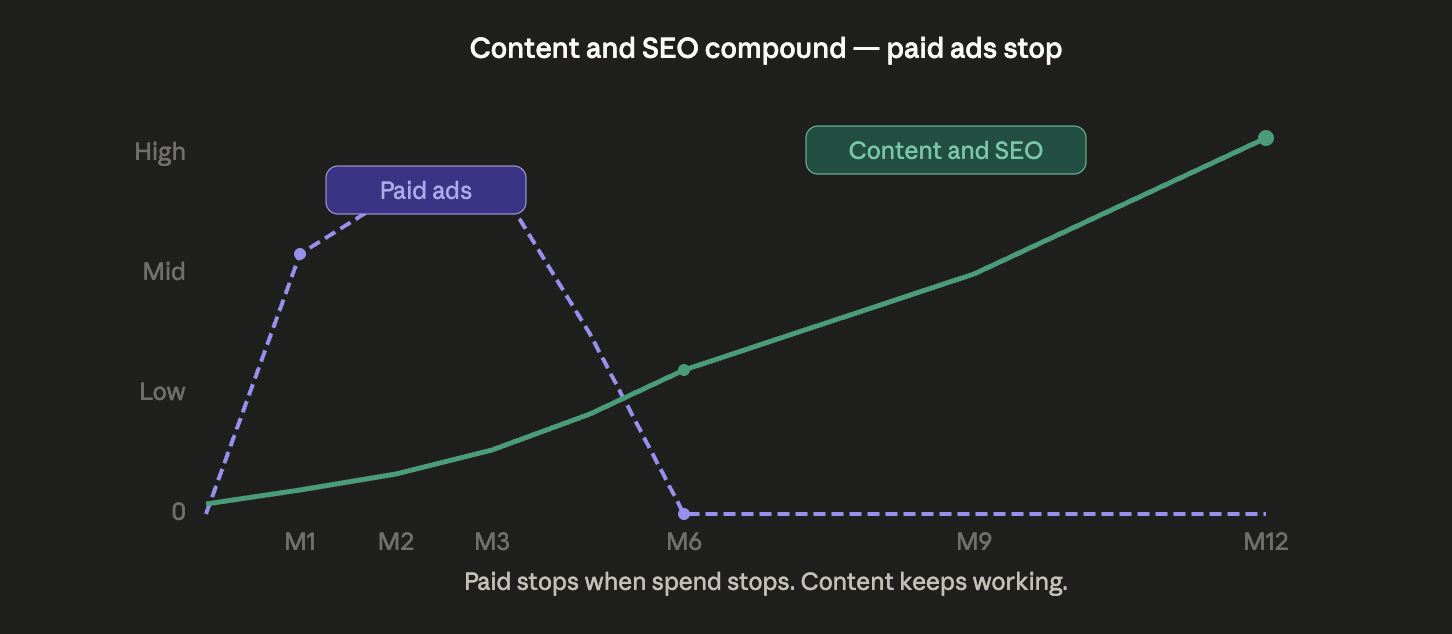
A well-optimised article ranking for a relevant keyword keeps generating organic traffic for months or years after you publish it. No paid advertising channel works that way. This matters especially in the crypto space because major advertising platforms still restrict crypto advertising significantly, making search visibility one of the primary organic growth channels available.
73% of potential crypto users need extensive education before adoption, which means there's enormous demand for clear, honest educational content from projects willing to provide it.
What to publish
In-depth guides, how-to tutorials, and comparative analyses build authority over time and create a body of work that positions your project as a credible source in the competitive crypto landscape. Publish less, but make each piece genuinely useful.
Choosing the right relevant keywords
Find topics where existing content is thin or outdated, then write the definitive piece. Most projects skip SEO because the payoff isn't immediate. That's exactly why it works; most projects won't put in the effort. The right relevant keywords are specific to your target audience's problems, not broad category terms that attract everyone and convert nobody.
Influencer Marketing as a Performance Channel
Influencer marketing in crypto is projected to reach $32.5 billion by 2025, which means the channel is maturing. The projects that treat it as a branding exercise are increasingly getting left behind by those that treat it as a performance channel.
Micro vs macro: which converts better
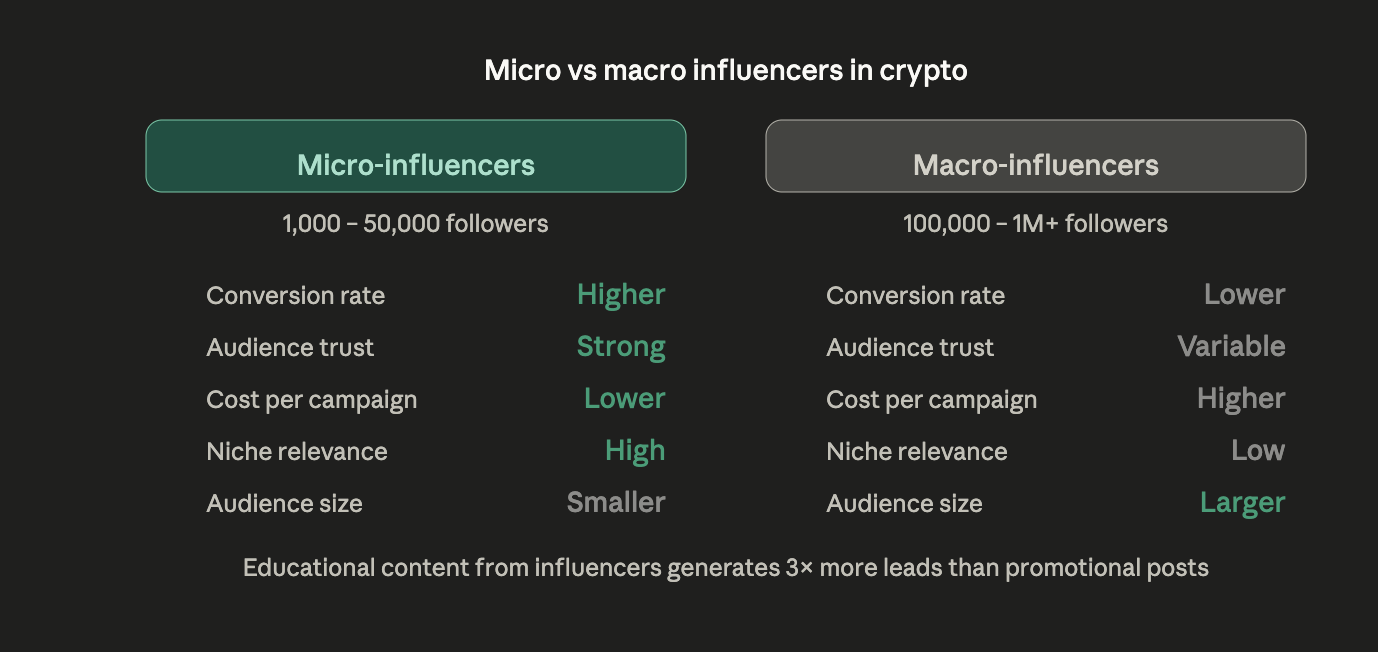
Micro-influencers yield better ROI than macro-influencers in the crypto space because their audiences are more targeted, more trusting, and more likely to act on a recommendation. Educational content from influencers generates three times more leads than promotional content, which means the best influencer campaigns are built around genuine education rather than hype.
Peer-to-peer recommendations within trusted communities convert better than celebrity endorsements seen by millions of passive followers.
How to structure influencer campaigns
When evaluating potential crypto influencers, the question to ask is not "how big is their audience?" but "does their audience overlap with my target audience, and does this person understand the project well enough to explain it clearly?" Influencers who can't explain your value proposition in their own words will generate noise without generating new users.
Structured campaign sequencing also matters. Building anticipation gradually, with whisper-stage mentions before full promotion, produces better results than single-moment launches. Treat influencer partnerships as performance channels with clear conversion tracking: wallet connections, not impressions; real users, not vanity metrics.
Launch Sequencing: Pre-Launch, Launch, and Post-Launch
One of the most expensive mistakes in crypto marketing is treating the token launch as the destination. It isn't. It's the beginning.
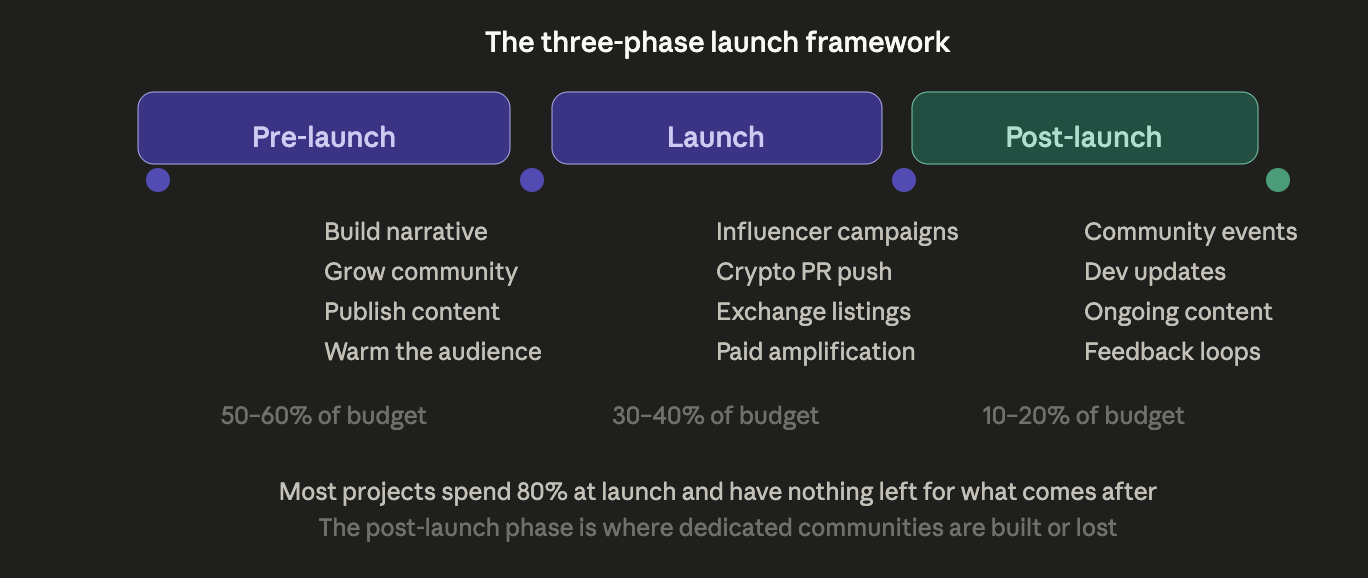
Pre-launch: build before you promote
Pre-launch is where the groundwork happens. Building your community before you have anything to sell is harder and slower, but it produces early users who have chosen to be there rather than been paid to appear. Setting up your social presence, publishing educational content, running AMAs, and establishing your narrative all belong in this phase. The goal is to create an audience that's ready to act when the launch comes.
Launch: amplify what you've built
The launch phase is about amplification: giving what you've built the best chance of reaching as many of the right people as possible. Influencer campaigns, crypto PR pushes, exchange listings, and paid advertising all belong here, but they work best when they're amplifying a story and community that already exist rather than trying to create them from nothing.
Post-launch: where most projects drop the ball
Post-launch is where most projects drop the ball. Projects that burn 80% of their marketing budget in the weeks around launch and have nothing left afterward consistently underperform those that have a crypto marketing plan across all three phases. The community that forms in the weeks after launch is often the most important one, and it needs attention: consistent communication, development updates, community events, and active engagement keep the momentum going and turn early adopters into long-term advocates.
Crypto PR: Building Credibility Through Media Coverage
Public relations builds trust and credibility in ways that paid crypto advertising cannot. A feature in a credible publication reaches an audience that has chosen to read that publication, which means the trust the publication has built transfers to some degree to your project.
Getting media coverage
Effective crypto PR requires clear communication of project goals and genuine transparency about where the project is in its development. Engaging with media outlets regularly, even when you don't have major announcements, builds relationships that pay off when you do. Transparency in PR enhances perceived authenticity, and perceived authenticity is one of the most valuable things a crypto project can have in a market where skepticism runs high.
Strategic partnerships as PR
Strategic partnerships with established brands, institutions, or other projects also fall under the PR umbrella. Clear value alignment is essential when leveraging partnerships; partnerships that don't make sense to your audience do more harm than good because they signal you're chasing association rather than building something real.
Budget Allocation by Project Stage
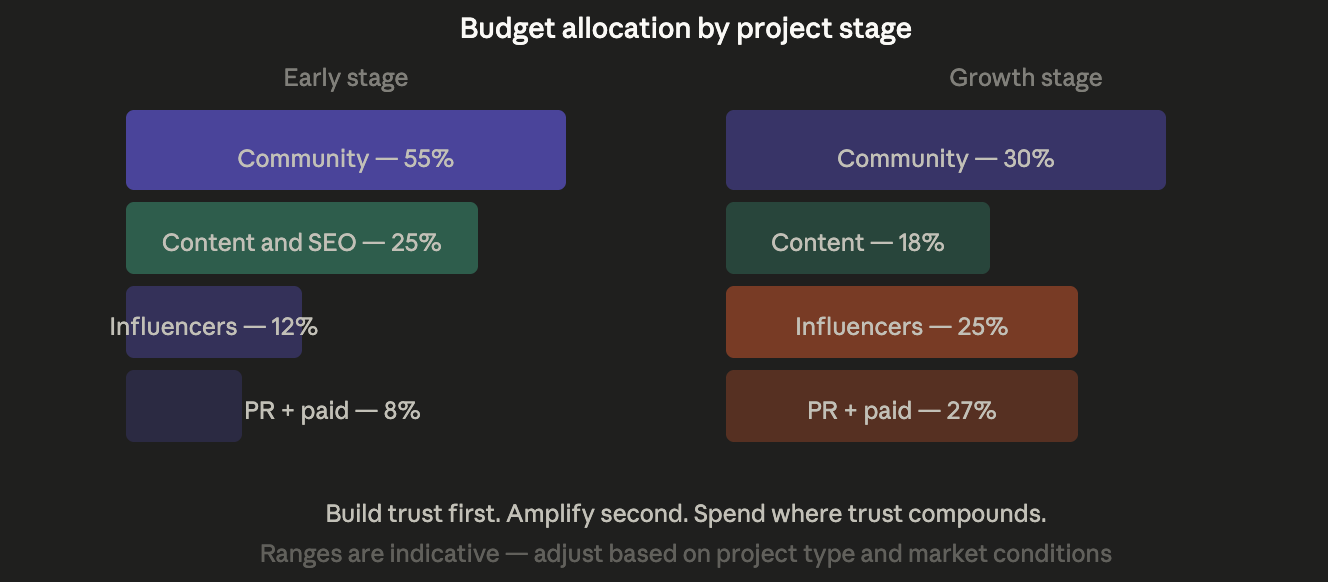
One of the most common questions in crypto marketing is how to allocate a marketing budget. The honest answer is that it depends heavily on the project's stage.
Early stage: trust-building first
Early stage projects with a priority on community and content marketing typically spend 50 to 60% of their budget on those channels before committing significant resources to amplification. The remaining budget goes to influencer partnerships and modest PR outreach; paid advertising at this stage rarely converts because the brand isn't established enough to justify the spend.
Growth stage: shift toward amplification
Growth stage projects, which have already established a community and proven some traction, often shift to 30% on community and content and allocate 25 to 30% each to influencer marketing and paid channels. Paid campaigns and crypto PR perform best once the foundation is already established.
A note on paid advertising
Crypto-specific ad networks exist specifically to navigate the restrictions that major platforms place on crypto advertising. They reach crypto-native audiences already familiar with the space, which lowers the education barrier. But paid channels are always amplifiers, not foundations. They work when the narrative, community, and content are already in place; when they're not, paid spend accelerates the wrong things.
Analytics Tools and Measuring Success
Effective crypto marketing requires a different approach to measuring success than traditional digital marketing.
What to actually track
On-chain analytics let you measure things that traditional metrics can't: wallet connections driven by specific campaigns, user behavior after connecting, and the retention of users acquired through different channels. These metrics tell you whether marketing is generating genuine engagement or just surface activity.
Key metrics to track include community growth rate and engagement quality, website traffic from organic and referral sources, conversion from traffic to wallet connections, community retention at 30, 60, and 90 days, and content performance by organic search ranking. Vanity metrics like follower counts and impression numbers should be contextualised against these numbers rather than treated as primary indicators of success.
Building your weekly review
The point isn't to drown in dashboards. Review four key numbers every Monday: where new users are coming from, which content is driving wallet connections, which channels produce the most engaged community members, and which campaigns are driving sustained activity versus short-term hype. If a channel is compounding, double down. If it's flat after two months, cut it.
Reviewing these numbers weekly, with a clear process for deciding what to double down on and what to cut, is what separates projects that improve their marketing over time from those that repeat the same mistakes.
Generative Engine Optimization: Getting Cited in AI Answers
The search landscape has shifted significantly. Google's AI Overviews, ChatGPT, Perplexity, and other AI-powered answer engines now handle a substantial portion of search intent that previously led to blog clicks.
Why GEO matters in 2026
For a crypto marketing strategy to be complete in 2026, it needs to account for how AI systems discover and cite information. Generative engine optimization, or GEO, is the practice of structuring content so that AI models are more likely to cite it when answering relevant questions.
How to structure content for AI citation
AI models prefer content with direct, quotable answers to specific questions; clear attribution to a named author or organisation; factual, verifiable claims rather than marketing language; and structured headings that make it easy to extract relevant sections.
For crypto projects, this means ensuring that content about your project is specific, accurate, and consistent across multiple sources. It means publishing content that AI models consider authoritative: content that is cited, linked to, and referenced by other credible sources. Structuring key pages, especially FAQ sections and educational content, with the kind of direct Q&A format that AI models extract easily is one of the most actionable steps any crypto project can take right now.
GEO and traditional SEO reinforce each other. The same content that ranks well in Google tends to get cited more often by AI models because both systems reward expertise, relevance, and trust signals. Building a content strategy that targets both simultaneously is the most efficient approach.
The Principle Everything Else Builds On
The entire field of crypto marketing, from community building to influencer campaigns to GEO, comes back to a single principle: spend where trust compounds, not where attention disappears.
Paid campaigns generate attention. Community, content, and PR generate trust. Trust is what converts attention into action, and action is what creates sustainable growth for a crypto business. Projects that invert this, spending on amplification before building trust, consistently see poor returns and often damage their reputation in the process.
The competitive crypto landscape rewards projects that are patient enough to build the foundation correctly. Narrative first, community second, content and SEO third, amplification fourth. Every step amplifies what's below it, and every step skipped creates a gap that shows up later as poor conversion, high churn, or a community that falls apart the moment price momentum slows.
Get the strategy right, execute consistently, measure honestly, and adjust based on what the data tells you. That's what successful crypto marketing looks like in 2026.
Contact a crypto marketing agency like GrowthChain to help guide you through the proven strategies and processes.
Frequently Asked Questions
What is a crypto marketing strategy?
A crypto marketing strategy is a structured plan for building awareness, trust, and demand for a blockchain or digital asset project. It covers how the project communicates its value, which channels it prioritises, how it builds and retains a community, and how it measures the impact of its marketing efforts.
How is crypto marketing different from traditional marketing?
Crypto marketing differs in three key ways: trust is the primary variable rather than attention; the community is part of the product rather than just the audience; and regulatory compliance shapes what can be said and where.
What should a crypto marketing budget prioritise?
Early stage projects should prioritise community building and content marketing, typically allocating 50 to 60% of the budget there before spending on amplification. Growth stage projects shift more toward influencer marketing and paid channels once the foundation is established.
How long before crypto marketing starts working?
Community building shows meaningful results in weeks. Content marketing and SEO take 3 to 6 months to build momentum but compound for years. Paid advertising produces faster results but stops the moment you stop spending.
What is GEO and why does it matter for crypto projects?
Generative engine optimisation (GEO) is the practice of structuring content so that AI-powered answer engines like ChatGPT and Google's AI Overviews are more likely to cite it. As AI handles more search queries directly, being cited in those answers is increasingly important for reaching potential users.
Should crypto projects build in-house or work with a crypto marketing agency?
Build community in-house; it needs authentic voices who genuinely believe in the project. Outsource specialised work like SEO, paid campaigns, PR, and content production to a crypto marketing agency with existing relationships and specialised knowledge in the crypto space.
What's the biggest mistake crypto projects make?
Spending on short-term hype instead of long-term trust. Build the foundation first, amplify second.

From The Blog
You may also like


Stop Guessing. Start Scaling.
Data-driven crypto marketing that actually delivers users, not vanity metrics.

GrowthChain is a disruptive web3 marketing agency looking to propel your customer base. We focus on DAOs, DeFi, NFT and Crypto projects.

GrowthChain Designed, 2025
.svg)