






How to Rank a Crypto Project in Google: Step-by-Step
Ranking a crypto website in Google is one of the harder things you can attempt in SEO, and also one of the most rewarding. Hard, because the crypto space is fiercely competitive and Google holds cryptocurrency sites to unusually high trust standards. Rewarding, because organic search is one of the few channels where crypto projects can reach serious, high-intent users without fighting the advertising restrictions that block most paid options.
The good news is that ranking a crypto project isn’t a mystery. It follows a sequence, and the projects that work through that sequence patiently tend to pull ahead of the many that skip steps and wonder why nothing moves. This guide walks through that sequence, step by step, from getting your site indexed to measuring and refining your results. It builds on our complete crypto SEO guide, which covers the full discipline; this article is the practical path to actually ranking.
The Three Pillars Underneath Everything
Before the steps, it helps to hold the big picture in mind. Crypto SEO rests on three core pillars: speed, visibility, and trust. Speed means a fast, technically sound site. Visibility means content built around what your audience actually searches. Trust means the signals that convince Google, and users, that your project is credible in a space full of scams. Every step below serves one of these three pillars.
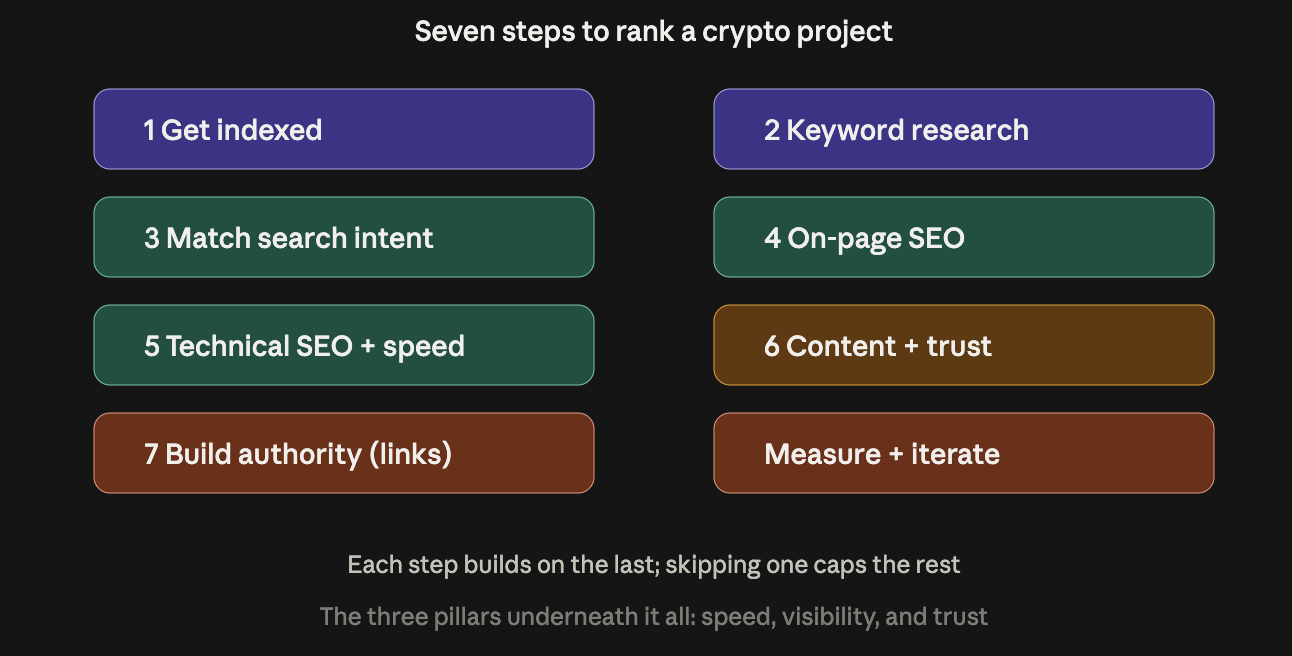
With that frame in place, here’s the path.
Step 1: Make Sure Google Can See Your Site
It sounds obvious, but the most common reason a crypto site doesn’t rank is that Google can’t properly crawl or index it in the first place. No ranking is possible for a page search engines can’t see.
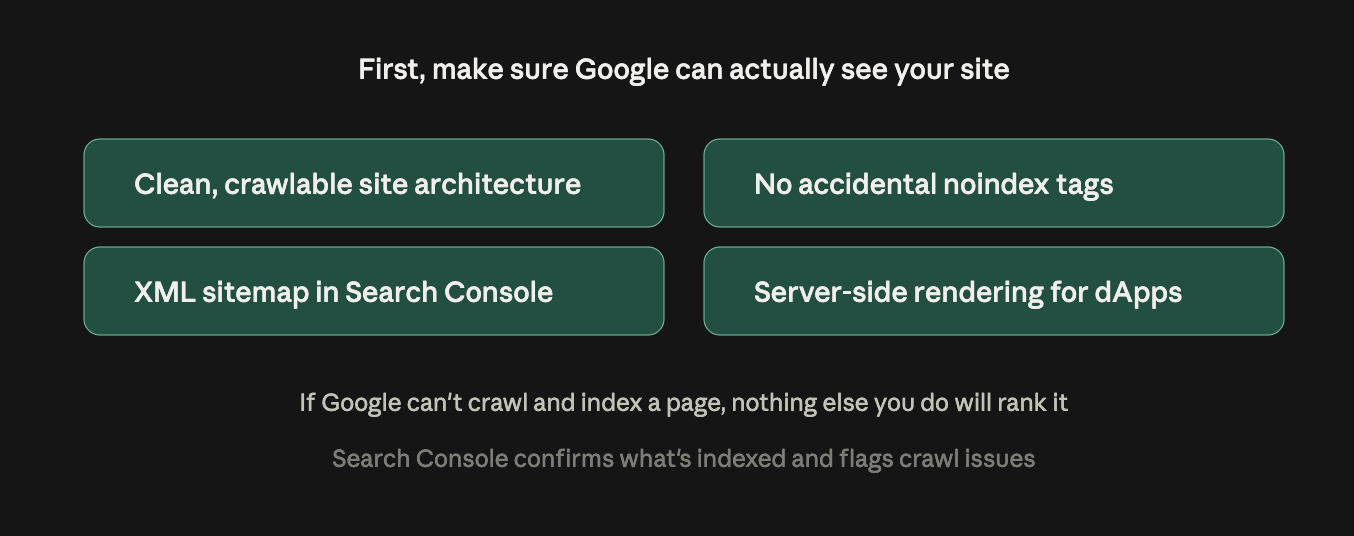
Start by maintaining a clean site architecture so every important page is reachable and indexable. Submit an XML sitemap through Google Search Console so Google knows what exists and can find it quickly. Check that you haven’t accidentally left noindex tags or robots rules blocking pages that should rank; this happens more often than you’d think, especially on sites built from templates.
Crypto sites have one extra trap here. Many are built as JavaScript-heavy applications, and if your content only loads in the browser via JavaScript, Google’s crawler may see an empty page. Server-side rendering fixes this by delivering the full content upfront so search engines can read it. For any crypto platform built on a modern framework, this is one of the highest-impact technical steps you can take.
Google Search Console is your source of truth throughout. It confirms what’s actually indexed, flags crawl errors, and shows you how Google sees your site. It should be the first tool you set up and the first place you look when something’s wrong.
Step 2: Research the Right Keywords
Once Google can see your site, the next question is what you want to rank for. This is where keyword research comes in, and in crypto it’s a moving target because the terms people search shift constantly with the market.
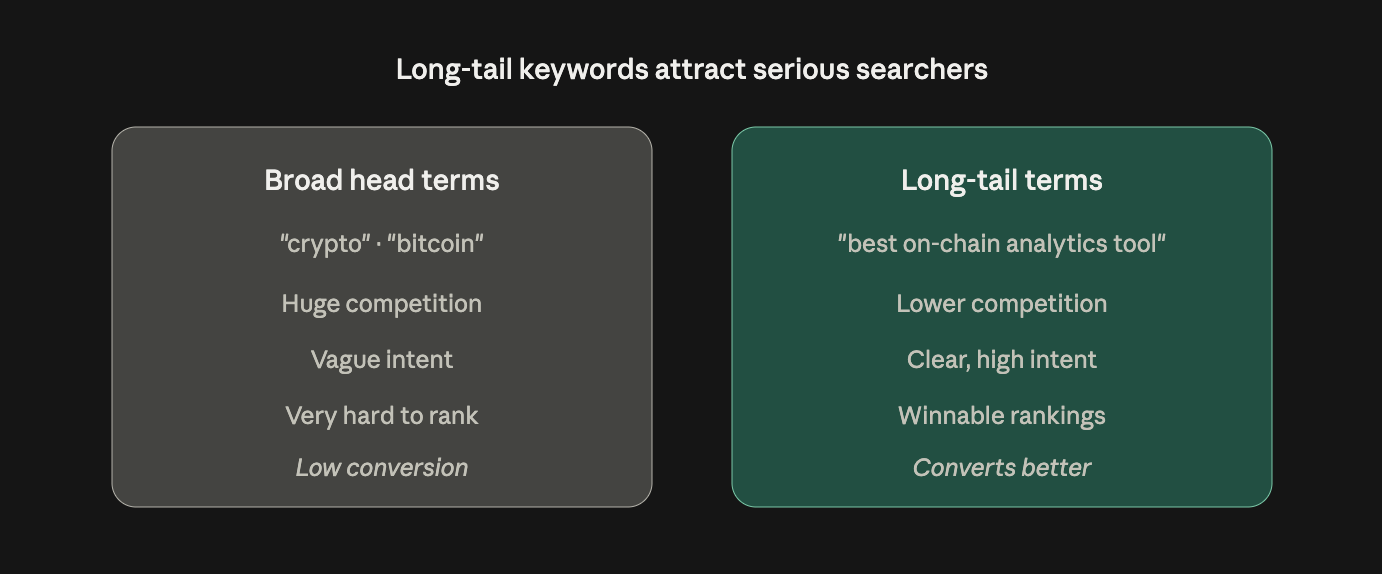
The single most important principle here is to target long-tail, high-intent keywords rather than broad head terms. Trying to rank for “crypto” or “bitcoin” is a losing game; those terms are impossibly competitive and the intent behind them is vague. Long-tail keywords attract more serious searchers, the people who know what they want and are closer to taking action. Someone searching “best on-chain analytics tool for traders” is far more valuable, and far more winnable, than someone searching “crypto.”
Keyword research is really about understanding how your audience searches for solutions. Tools like Ahrefs and SEMrush reveal search volume and competition so you can find the terms worth targeting. But because crypto jargon and search demand evolve so fast, you have to revisit your keyword strategy regularly rather than setting it once. Semantic search means Google now rewards content that covers a topic with real depth, so think in terms of the whole question your audience is asking, not just the exact phrase.
Step 3: Match Content to Search Intent
Finding the right keyword is only half the job. The other half is matching what you publish to the intent behind the search, because a page that targets the right keyword with the wrong content type won’t rank.
Align user intent with content type. If someone searches a question, they want an answer, so give them a clear, well-structured explanation. If they search a comparison, they want options weighed against each other. If they search to take an action, they want a page that lets them do it quickly, with the information and buttons they need right there. Getting this match right is often the difference between a page that ranks and one that doesn’t, even when both target the same keyword.
This is also where you make content easy for both users and AI to extract. Using clear question-and-answer formats and concise definitions keeps users engaged and informed, and it makes your content far easier for search engines and AI answer engines to understand and surface. Well-structured content that directly addresses user needs is what both algorithms and readers reward.
Step 4: Nail On-Page SEO
On-page SEO is where you optimise each page so Google clearly understands what it’s about and who it’s for.
The fundamentals still matter. Work your target keyword naturally into the title tag, meta description, headings, and body, giving searchers a clear reason to click from the results page. Structure content with logical headings that signal the page’s topic. Use relevant keywords throughout without forcing them, since stuffing hurts more than it helps now.
Internal linking is one of the most underused on-page tactics. Linking related pages together helps Google understand your site structure, spreads authority across your pages, and keeps users moving through your content. This is also how you build topical authority, which we’ll come to. A well-linked site ranks better than the same content sitting in disconnected pages.
Step 5: Get the Technical Foundation and Speed Right
Technical SEO and site speed form the first pillar, and in crypto they carry extra weight because your users are often about to make financial decisions on your site.
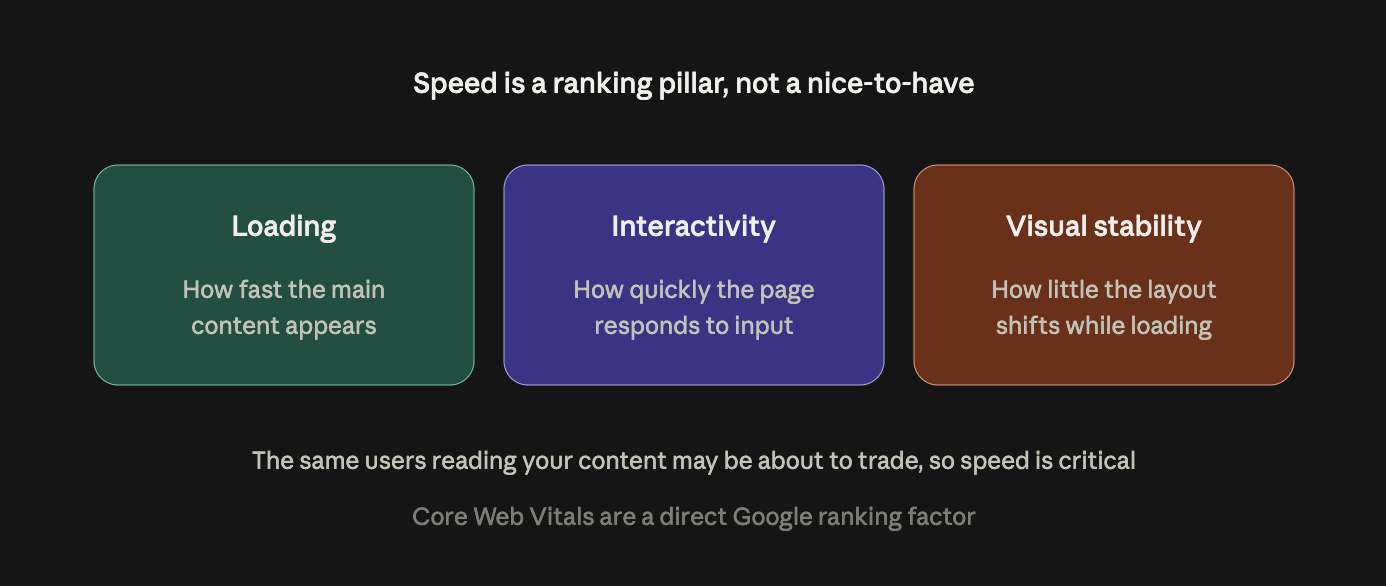
Core Web Vitals measure site speed and user experience across three dimensions: how fast your main content loads, how quickly the page responds to interaction, and how little the layout shifts while loading. They’re a direct Google ranking factor, and they matter doubly for crypto, since the same users reading your content may be about to trade on your platform, where a slow or unstable page costs you both rankings and trust.
Beyond Core Web Vitals, the technical checklist includes mobile optimization, since so much crypto activity happens on phones, schema markup to help search engines understand your content and earn rich results, and resolving any crawl errors that waste Google’s attention. Get the technical foundation solid and everything else you build on top performs better.
Step 6: Publish Content That Earns Trust
Content is where rankings are won, but in crypto it’s not just about quality, it’s about trust. Google classifies cryptocurrency content as YMYL, “your money or your life,” which means it holds crypto sites to higher standards of accuracy and credibility than almost any other niche.
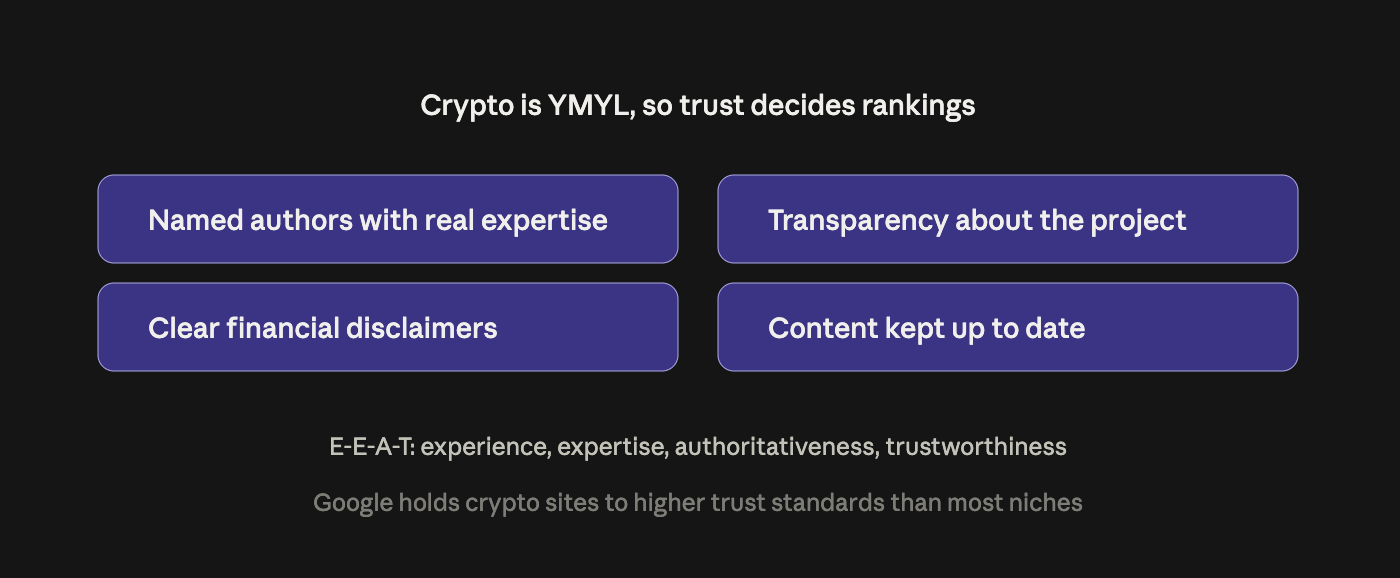
E-E-A-T, standing for experience, expertise, authoritativeness, and trustworthiness, is the framework Google uses to judge this. For a crypto site, that translates into concrete signals. Publish detailed content under named authors with real expertise, not anonymous posts. Include clear financial disclaimers, which serve both compliance and user trust. Be transparent about your project, your team, and your data. And update content regularly, since freshness signals to search algorithms that your site is actively maintained and reliable.
The content itself has to genuinely address user needs. High-quality content that answers the question thoroughly, backed by research and written for your specific audience, is what ranks and keeps users engaged. Thin content chasing keywords doesn’t clear the YMYL bar; the clearest, most trustworthy answer available does.
Then there’s topical authority. Rather than publishing scattered one-off posts, group related content into interconnected topic clusters, a central pillar page on a broad topic supported by deeper articles on its subtopics, all linked together. This structure signals to Google that you have genuine depth on a subject rather than a shallow take, and it’s one of the most effective long-term ways to build ranking authority in crypto.
Step 7: Build Authority Through Backlinks
Even the best content needs authority behind it to rank in a competitive niche, and authority comes largely from backlinks. Backlinks are the currency of trust in SEO; they’re how other sites vouch for yours.
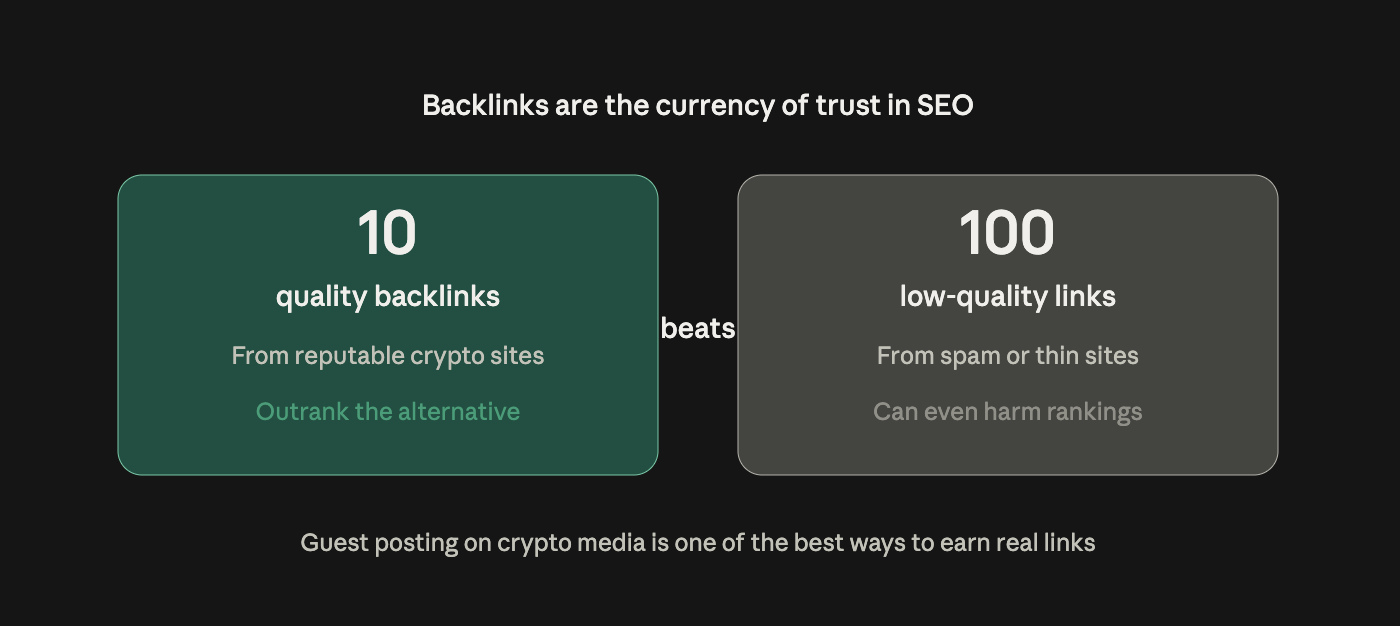
The crucial principle is quality over quantity. A single link from a reputable crypto site is highly valuable, and ten high-quality backlinks outperform a hundred low-quality ones. In fact, low-quality and spammy links can actively harm your rankings rather than help, which is a particular risk in a niche as spam-prone as crypto. The goal is a small number of genuinely authoritative links, not a large pile of worthless ones.
Guest posting on reputable crypto media is one of the most reliable ways to earn these links while putting your expertise in front of new audiences. Earning coverage through genuinely newsworthy work, getting listed in credible directories, and building real relationships with crypto publications all generate the kind of links that move rankings. This is slow, deliberate work, but it’s what separates sites that rank from sites that stall.
Step 8: Measure, Refine, and Repeat
Ranking a crypto project isn’t a one-time push; it’s a loop. The final step is measuring what’s working and feeding that back into everything above.
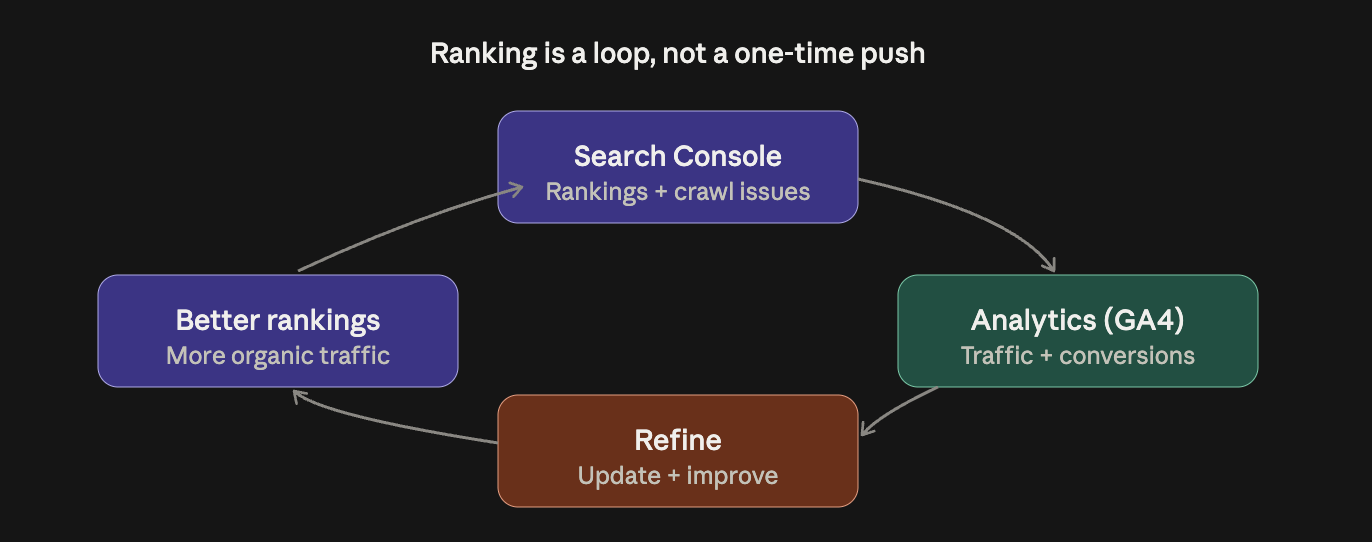
Google Search Console shows you keyword performance, which pages are ranking, impressions, clicks, and any crawl issues that need fixing. Google Analytics and GA4 track organic traffic, engagement rate, user behavior, and organic conversions, telling you not just whether people arrive but whether they do anything once they’re there. Together they give you the full picture of your SEO performance.
Use that picture to refine. Update content that’s slipping, double down on topics that are gaining traction, fix technical issues as they surface, and revisit your keyword strategy as the market shifts. Monitoring performance and acting on it is what turns a static site into one that climbs steadily over time. The projects that rank consistently are the ones that treat SEO as an ongoing cycle, not a box to tick once.
Ranking Takes Time, but It Compounds
There’s no shortcut to ranking a crypto project in Google. It takes getting indexed cleanly, targeting the right long-tail keywords, matching content to intent, building a fast and technically sound site, publishing trustworthy content under real expertise, earning quality backlinks, and refining continuously based on real data. Technical fixes can show results within weeks, but content and authority typically take three to six months to gain real traction, then compound from there.
That patience is exactly why ranking is so valuable. Most crypto projects won’t do the work, which means the ones that do end up owning the search results their competitors gave up on. In a space where paid channels are restricted and trust is scarce, a crypto site that ranks organically has built something durable that keeps delivering long after the work is done.
Ranking a crypto project in Google is demanding, and the trust and technical bar in this niche is unforgiving of mistakes. At GrowthChain, we help crypto projects climb the rankings with SEO strategies built for the realities of the crypto space, from technical audits and content clusters to trust signals and link building. If you want your project ranking where your audience is searching, get in touch with our team and let’s build your path to the top of the results.
Frequently Asked Questions
How do you rank a crypto project in Google?
Rank a crypto project by making sure the site is indexable, researching long-tail high-intent keywords, matching content to search intent, optimising on-page and technical SEO, building a fast site, publishing trustworthy content under named experts, earning quality backlinks, and continuously measuring and refining in Search Console.
How long does it take to rank a crypto website?
Technical fixes can show results within weeks, but content and authority building typically take three to six months to gain meaningful traction. Crypto SEO rewards consistency, and rankings compound over time rather than appearing overnight.
Why isn’t my crypto site ranking?
The most common reasons are indexing problems (often from JavaScript rendering that hides content from Google), targeting keywords that are too competitive, thin content that doesn’t meet YMYL trust standards, weak backlink authority, or slow site speed. Search Console will reveal most of these.
What keywords should a crypto project target?
Target long-tail, high-intent keywords rather than broad terms like “crypto” or “bitcoin.” Long-tail phrases attract more serious searchers, face less competition, and convert better. Use tools like Ahrefs and SEMrush and revisit your SEO strategy regularly as the market shifts.
Why does Google treat crypto sites differently?
Google classifies cryptocurrency content as YMYL (“your money or your life”), meaning it holds these sites to higher standards of accuracy, expertise, and trustworthiness. Strong E-E-A-T signals like named expert authors, transparency, and clear disclaimers are essential to rank.
How many backlinks does a crypto site need to rank?
Quality matters far more than quantity. Ten high-quality backlinks from reputable crypto sites outperform a hundred low-quality ones, and spammy links can actively hurt your rankings. Focus on earning a small number of genuinely authoritative links through guest posting, PR, and real relationships.

From The Blog
You may also like




Stop Guessing. Start Scaling.
Data-driven crypto marketing that actually delivers users, not vanity metrics.

GrowthChain is a disruptive web3 marketing agency looking to propel your customer base. We focus on DAOs, DeFi, NFT and Crypto projects.

GrowthChain Designed, 2025
.svg)