






Every crypto project wants to be found. Very few are. The average project pours its energy into a token launch, a Twitter presence, and a round of influencer deals, then wonders why nobody discovers it through search. Meanwhile the projects that quietly invested in crypto SEO are pulling in qualified organic traffic month after month, at a fraction of the cost, from people actively searching for exactly what they offer.
Crypto SEO is search engine optimization adapted to one of the hardest niches on the internet. It's harder than standard SEO because the crypto market is more competitive, more volatile, more heavily scrutinised by search engines, and more technically awkward to crawl. But it's also more valuable, precisely because paid channels are so restricted. When you can't buy your way in, ranking organically becomes the difference between a project people find and one they never hear about.
This guide is the complete picture: why crypto SEO is different, the four pillars that make it work, and how to build search visibility that lasts through market cycles and the shift to AI-driven search. It connects to our ultimate crypto marketing strategy guide, where content and SEO is one channel among many; here we go deep on that channel alone.
Why Crypto SEO Is Different
Before any tactics, it's worth understanding why SEO for crypto demands its own playbook rather than a generic one.
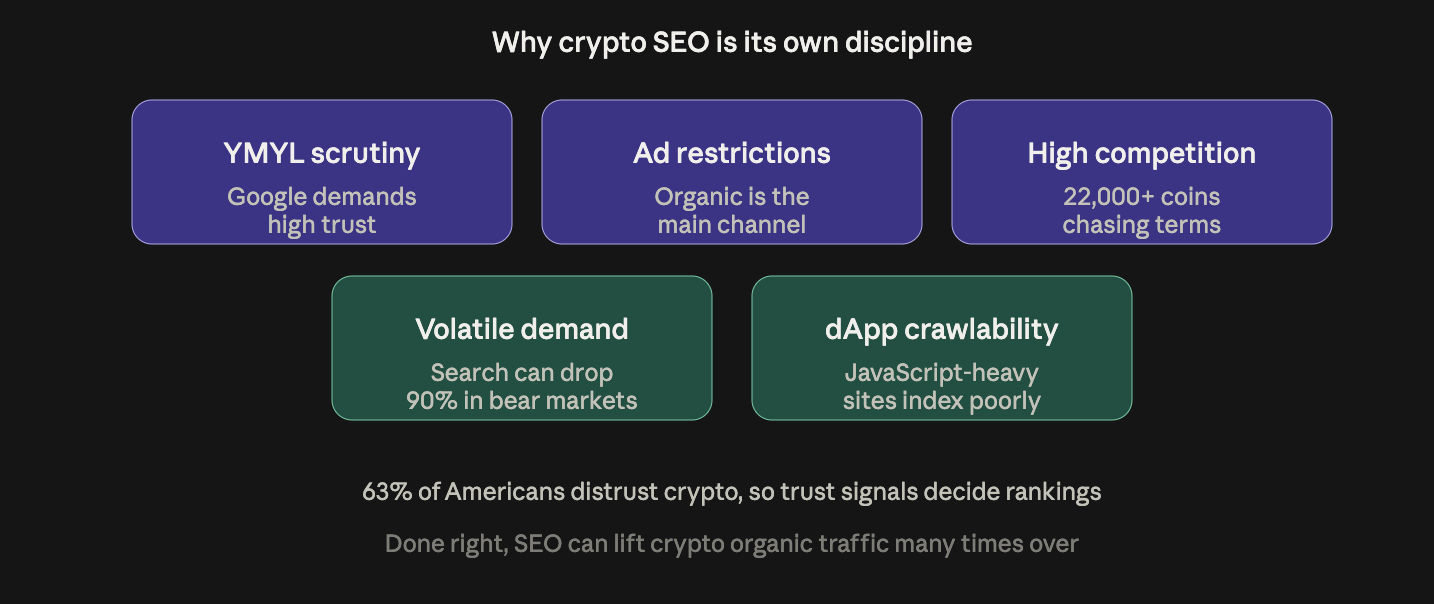
The first reason is trust. Google classifies cryptocurrency content as YMYL, "your money or your life," which means it holds crypto pages to a much higher standard of accuracy and trustworthiness than ordinary content. This isn't arbitrary. 63% of Americans lack confidence in cryptocurrency safety according to Pew Research, and only around 5% are very confident in it. Search engines respond to that public skepticism by demanding stronger trust signals before they'll rank a crypto site. Get trust wrong and no amount of technical optimization will save your rankings.
The second reason is that organic search is often the main channel available. Major advertising platforms restrict or ban crypto advertising entirely, and even where crypto ads are permitted, search engines enforce heavy restrictions. That pushes crypto companies toward organic search traffic as their primary discovery channel, which raises the stakes on getting SEO right.
The third reason is competition. Over 22,000 cryptocurrencies exist, and they're all chasing overlapping keywords. High-intent terms in the crypto niche are ferociously contested, and standing out requires more than publishing a few blog posts.
The fourth is volatility. Search demand for crypto terms can swing dramatically with market cycles, dropping by as much as 90% during bear markets and surging in bull runs. A content strategy that ignores these cycles will chase demand that has already evaporated. The keywords that matter shift constantly as crypto jargon evolves, so keyword research is never a one-time exercise.
The fifth is technical. Many crypto sites are JavaScript-heavy dApps, and JavaScript rendering creates crawlability issues that can leave search engines unable to see your content at all. We'll come back to this, because it's one of the most common and most damaging crypto SEO challenges.
Put all that together and the picture is clear: crypto SEO is a distinct discipline. But the payoff justifies the difficulty. Done well, SEO can drive dramatic increases in organic traffic for crypto sites, and crypto sites that maintain an active blog pull significantly more traffic than those that don't. The upside is real; it just has to be earned.
The Four Pillars of Crypto SEO
Successful crypto SEO rests on four pillars, and they work together. A gap in any one caps the return on the others.
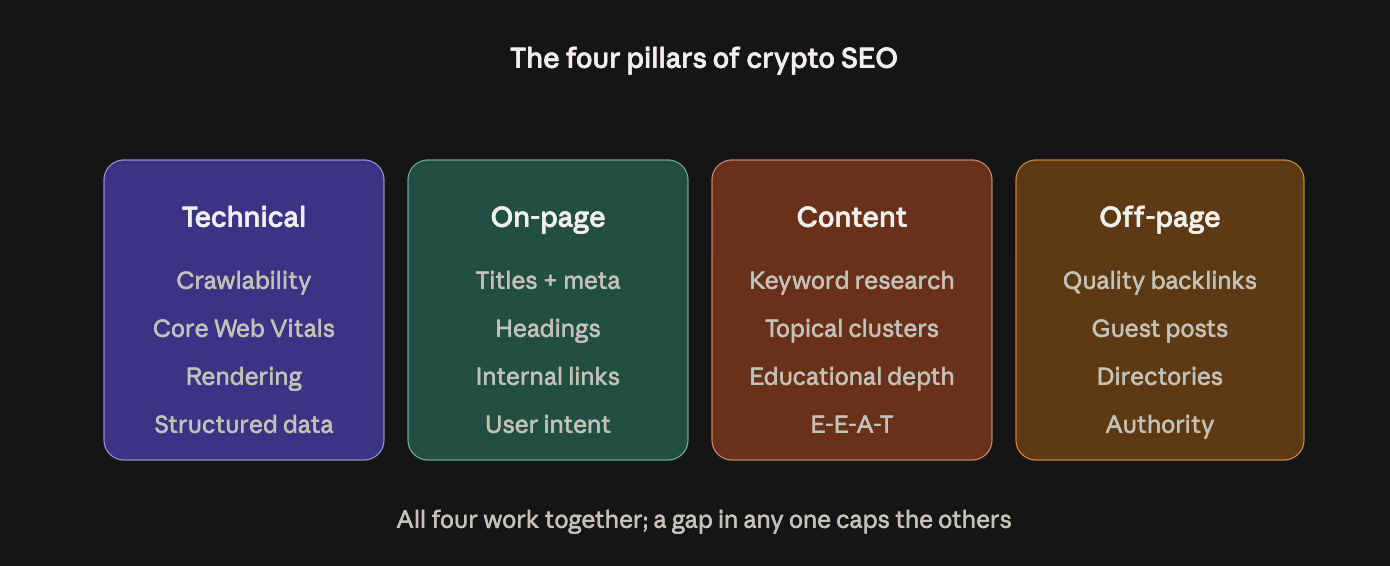
Technical SEO makes sure search engines can crawl, render, and index your site. On-page SEO optimises individual pages for their target keywords and user intent. Content and keyword strategy targets the terms your audience actually searches and builds the depth that establishes authority. Off-page SEO builds the backlinks and reputation signals that tell search engines your site can be trusted. The rest of this guide works through each in turn.
Pillar 1: Technical SEO
Technical SEO is the foundation, because if search engines can't properly access your site, nothing else matters. For crypto sites, this pillar carries extra weight because of how these sites are typically built.
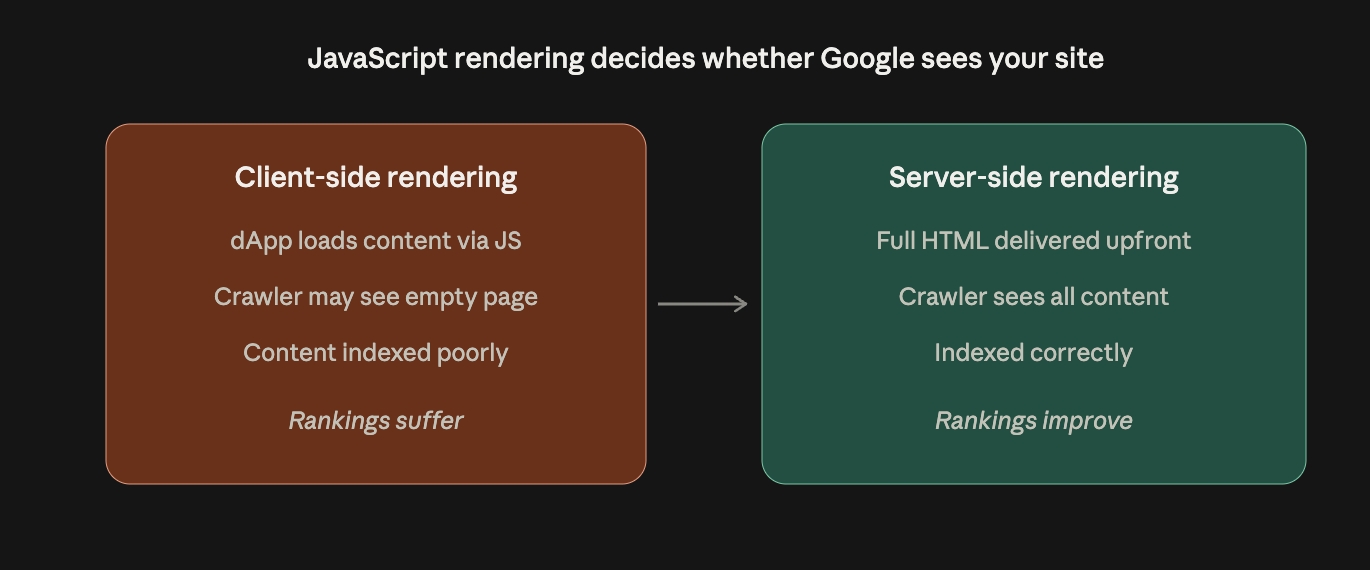
The single biggest technical issue in crypto SEO is JavaScript rendering. Many crypto trading platforms and dApps are built as JavaScript-heavy applications that load their content dynamically in the browser. The problem is that when a search engine crawler visits a client-side rendered page, it may see an almost empty page, because the content hasn't been rendered yet. The result is that your crypto content gets indexed poorly or not at all, and your rankings suffer regardless of how good the content is.
The fix is server-side rendering, which delivers the full HTML to the crawler upfront so that search engines see all your content immediately. For any crypto site built on a modern JavaScript framework, ensuring content is server-side rendered or pre-rendered for crawlers is one of the highest-impact technical changes you can make. It's the difference between a site Google can read and one it effectively can't.
Beyond rendering, the technical fundamentals still apply, and they matter more in a YMYL niche. Core Web Vitals measure loading speed, interactivity, and visual stability, and they're a genuine ranking factor. A secure crypto trading platform or exchange that loads slowly loses both rankings and users, since the same people reading your content are often about to trade on your platform, where performance is critical. Mobile optimization is non-negotiable given how much crypto activity happens on phones.
Structured data is especially valuable in crypto. Schema markup helps search engines understand the context of your crypto content, which improves how your pages appear in search results and increases the chance of earning rich snippets. Adding structured data for articles, FAQs, and organizations helps search engines understand what your pages are about and who stands behind them.
The rest of the technical checklist rounds out the pillar: a clean XML sitemap so search engines can find all your pages, resolution of crawl errors that waste crawl budget, a logical site architecture, and secure, canonical URLs. Google Search Console is the tool that surfaces most of these issues, and it should be the first place you look when rankings move unexpectedly. Google Analytics tracks what happens once visitors arrive, closing the loop on SEO performance.
Pillar 2: On-Page SEO
On-page SEO is where individual crypto pages get optimised to rank for their target keywords while genuinely serving the people who land on them.
The foundation of on-page SEO is intent. User intent in crypto SEO should focus on educational and problem-solving keywords rather than generic terms, because those are the queries where you can both rank and convert. Every page should be built around a clear primary keyword and the specific intent behind it, whether that's someone trying to understand a concept, compare options, or take an action.
The mechanical elements still matter. Title tags and meta descriptions should include the target keyword and give searchers a clear reason to click from the search engine results pages. Headings should structure the content logically and signal the page's topic. Keyword optimization should be natural, working relevant keywords into the content where they fit rather than stuffing them in. Content optimization means matching the depth and format of what already ranks, then exceeding it.
Internal linking is one of the most underused on-page tactics in crypto. Internal links help organize site structure and navigation, distribute authority across your pages, and show search engines how your content connects. A crypto project with a well-linked content library ranks better than one with the same content sitting in isolation. This is also where topical authority gets built, which we'll come to shortly.
Pillar 3: Content and Keyword Strategy
Content is where crypto SEO is won or lost. The technical and on-page pillars make your content rankable; the content itself is what actually ranks.
Keyword research that reflects real intent
Effective keyword research identifies the terms crypto users actually search, not the terms you assume they do. Tools like Ahrefs and SEMrush reveal search volume and competition levels, letting you find the keywords worth targeting. But crypto keyword research has a wrinkle most niches don't: keywords can swing dramatically with market cycles, and crypto jargon evolves fast, so research has to be ongoing rather than a one-time setup.
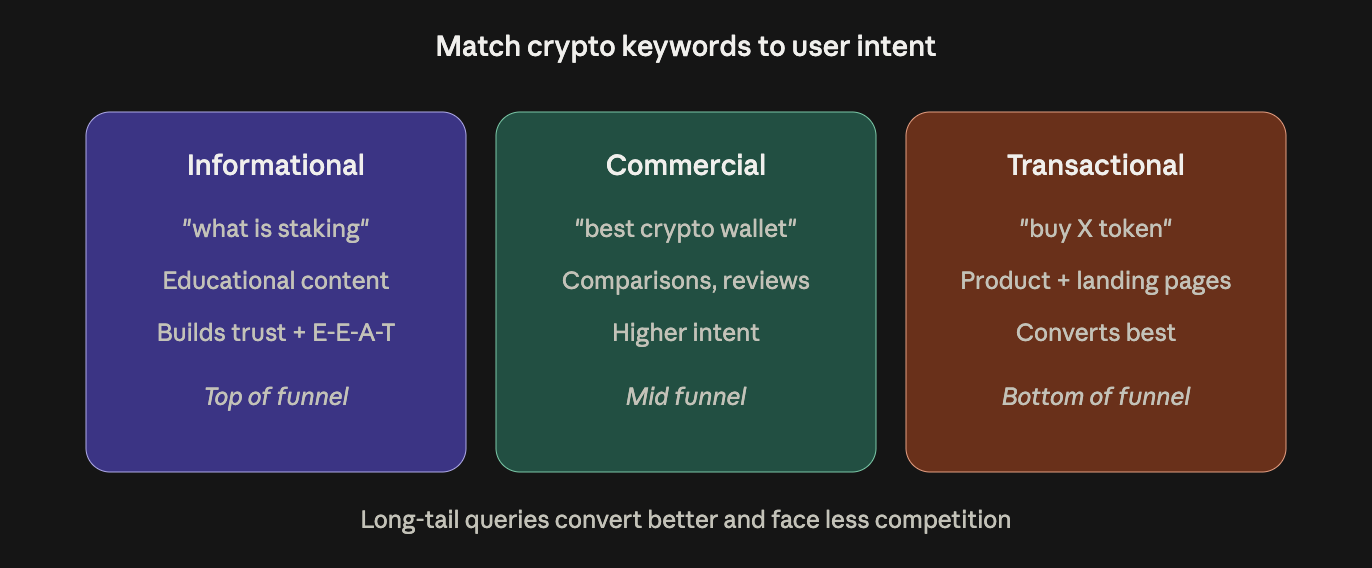
The most reliable strategy is to match keywords to intent and to favour long-tail queries. Informational queries like "what is staking" attract top-of-funnel readers and build trust. Commercial queries like "best crypto wallet" reach people comparing options. Transactional queries like "buy X token" convert best but face the fiercest competition. Long-tail queries convert better and face less competition than broad head terms, which makes them the smartest place for most crypto projects to start. Trying to rank for "crypto" is a losing game; ranking for the specific, lower-competition terms your exact audience searches is winnable and far more valuable.
Content that earns trust
Because crypto is YMYL, content quality isn't just about ranking; it's about clearing the trust bar Google sets for the entire niche. Ranking for educational queries builds trust in a crypto project, and educational content that genuinely explains complex concepts is what performs. The projects that win at crypto content don't publish thin posts chasing keywords; they publish the clearest explanation of a topic available anywhere, which is what both readers and search engines reward.
This is also where you address the volatility problem. Content strategies should account for the fact that crypto search volume shifts with market sentiment, building a mix of evergreen educational content that holds value across cycles and timely content that captures surges in demand.
Topical authority through clusters
Individual articles rank; libraries of connected content dominate. The way to build lasting search visibility in crypto is through topical authority, achieved by covering a subject comprehensively across a cluster of interlinked pages.
A content cluster is a pillar page covering a broad topic, surrounded by supporting articles that each cover a subtopic in depth, all linked together. This structure tells search engines you have genuine expertise across the whole subject rather than a single shallow take. It's the model this very guide is part of. This crypto SEO pillar is supported by deeper articles on ranking a crypto project, on generative engine optimization, and on backlinks and negative SEO, each linking back here and to each other.
The same cluster logic extends across your whole site. Your crypto SEO efforts don't sit in isolation; they connect to every other area of your marketing, and each one reinforces the rest. A strong community is one of the clearest trust and engagement signals a project has, and it feeds directly into the E-E-A-T that search rankings depend on. PR and earned media generate exactly the kind of authoritative backlinks that off-page SEO relies on. Influencer and KOL activity amplifies reach in ways that complement organic discovery. And a token launch is the moment search visibility matters most, tying launch planning and SEO tightly together. The more these areas link to and strengthen one another, the more your site reads to search engines as a genuine authority rather than a scattering of unrelated pages.
Pillar 4: Off-Page SEO and Authority
Off-page SEO is everything that happens away from your own site to build its reputation, and in crypto it centres on two things: backlinks and E-E-A-T.
Backlinks that actually count
Quality backlinks signal trust in the crypto niche, and in a YMYL category that trust signal carries enormous weight. But the emphasis is firmly on quality. Links from reputable crypto publications outweigh many low-quality links, and a handful of links from respected crypto media does more for your rankings than hundreds of links from low-value sites.
The most effective link-building tactics for crypto are earned rather than bought. Guest posts on crypto media can enhance link building while putting your expertise in front of new audiences. Getting listed in reputable crypto directories builds both links and discoverability. Earning coverage from crypto media through genuinely newsworthy work generates the strongest links of all. This is one of the places crypto SEO and crypto PR overlap directly, since the media relationships that drive PR are the same ones that produce authoritative backlinks.
A word of caution specific to this niche: the crypto space is prone to scams and spam, and that extends to link building. Low-quality and manipulative link schemes are common, and they can actively harm your rankings rather than help. We cover this in depth in our dedicated article on crypto backlinks and avoiding negative SEO, but the principle is simple: pursue quality links from real sources, and monitor your backlink profile for toxic links you didn't build.
E-E-A-T: the trust layer
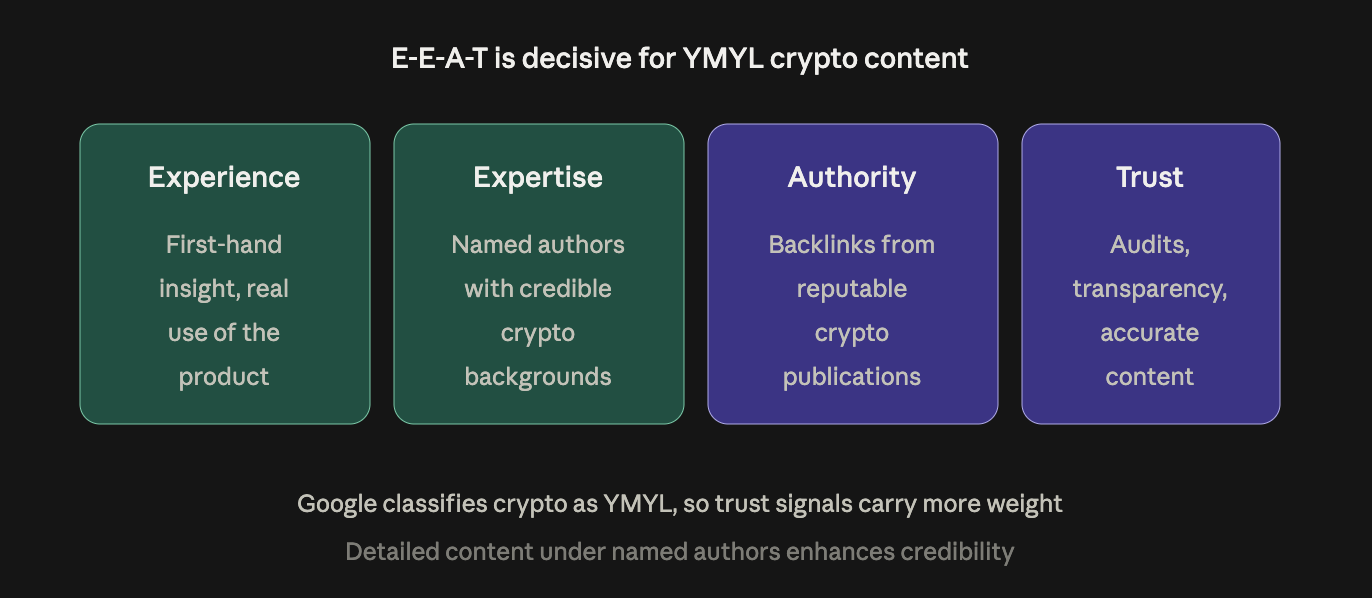
E-E-A-T, standing for experience, expertise, authoritativeness, and trust, is the framework Google uses to assess content quality, and it's decisive for YMYL crypto content.
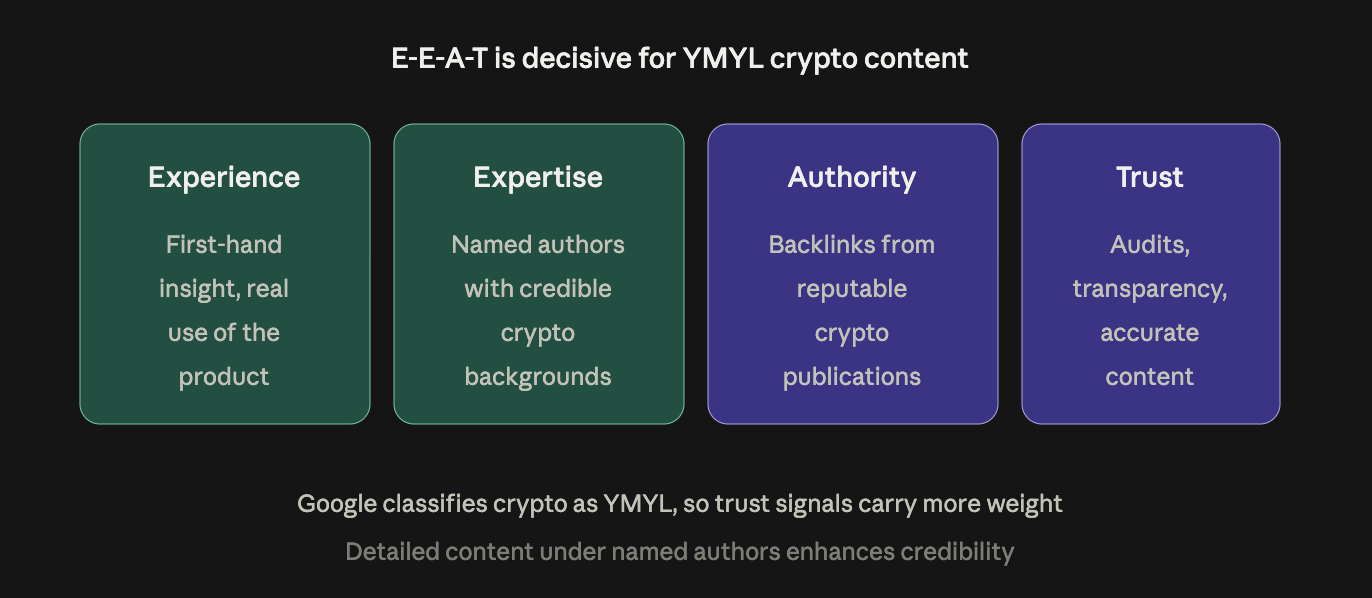
Each component has a crypto-specific expression. Experience means first-hand insight and real use of the products you write about. Expertise means detailed content published under named authors with credible crypto backgrounds, which enhances credibility significantly. Authoritativeness comes from backlinks and mentions from reputable crypto publications. And trust, the most important for YMYL, comes from published audits, transparency, accurate content, and a track record of reliability.
Building authority through thought leadership is how you strengthen all four at once. When your team publishes genuinely expert content under real names, earns citations from credible sources, and demonstrates real experience in the space, your E-E-A-T signals rise, and with them your rankings. In a niche where trust is the scarcest commodity, E-E-A-T is the crypto SEO lever with the most leverage.
The New Layer: SEO Meets GEO
No crypto SEO guide written in 2026 is complete without addressing the biggest shift in search since Google itself: the rise of AI-driven answers.
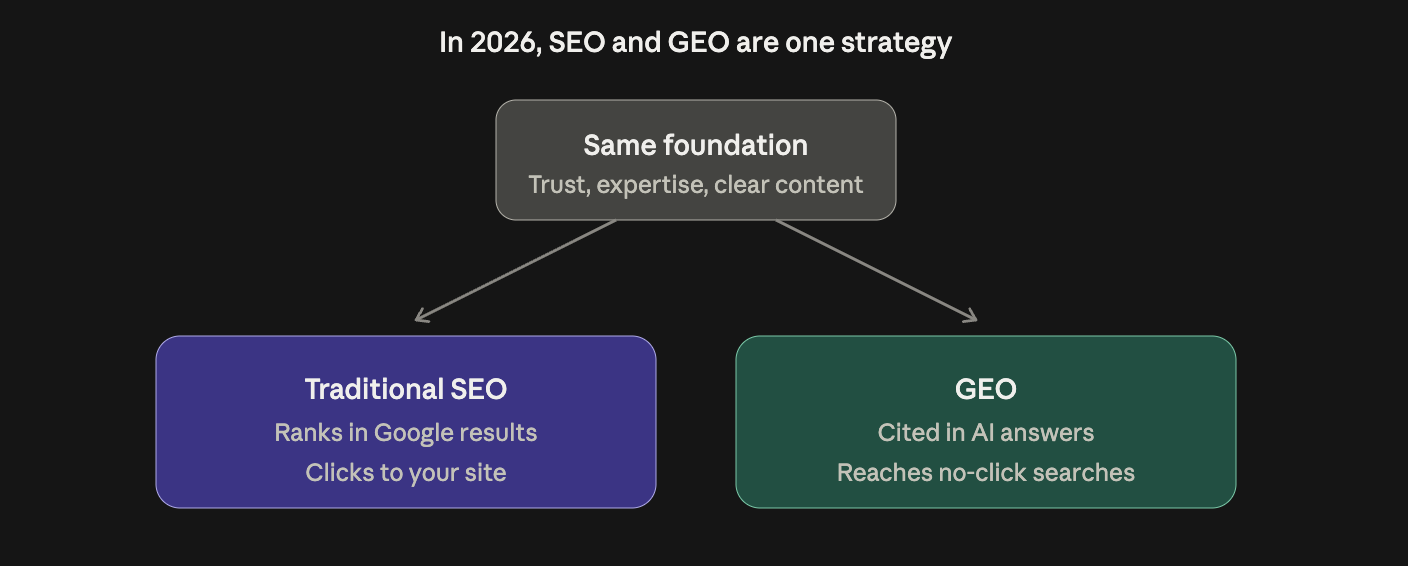
Google's AI Overviews, along with ChatGPT, Perplexity, Claude, and other AI answer engines, now resolve a large share of search queries directly, without the user ever clicking through to a website. For informational crypto content in particular, this has changed the game. Ranking first for "what is a crypto wallet" means less than it used to if an AI answer sits above your result and satisfies the searcher before they scroll.
The response is generative engine optimization, or GEO: structuring content so that AI models are more likely to cite it in their answers. The encouraging news for anyone who has invested in real crypto SEO is that SEO and GEO share the same foundation. Both reward trust, expertise, clarity, and authoritative sourcing. The same content that ranks well in Google tends to get cited more by AI models, because both systems are trying to surface the most credible answer.
There are GEO-specific techniques, from structuring content in direct question-and-answer formats to making key facts easily extractable, and we cover them fully in our dedicated GEO article. The strategic point for this guide is that SEO and GEO are no longer separate efforts. They're one integrated approach to search visibility, and treating them together is the most efficient way to stay discoverable as search continues to shift.
Measuring Crypto SEO Success
SEO without measurement is guesswork, and crypto SEO gives you strong tools to measure with. Google Search Console shows you impressions, clicks, average position, and which queries you're ranking for, making it the primary dashboard for SEO performance. Google Analytics shows what visitors do once they arrive: which content drives engagement, where organic traffic converts, and how SEO traffic compares to other channels.
The metrics that matter most are organic search traffic growth, keyword rankings for your target terms, and, crucially, what that traffic does once it lands. SEO can drive qualified leads at meaningful conversion rates, so the ultimate measure isn't traffic volume alone but whether that organic traffic turns into the outcomes your crypto business cares about. Track rankings and traffic, but tie them back to real results.
Building Crypto SEO That Lasts
Crypto SEO rewards patience and punishes shortcuts. The four pillars, technical foundations, on-page optimization, content and keyword strategy, and off-page authority, work together to build search visibility that compounds over time. Layer GEO on top, account for the volatility of the crypto market, and clear the trust bar that YMYL classification demands, and you have a discovery channel that keeps working long after any single campaign ends.
The projects that dominate crypto search aren't the ones that spent the most; they're the ones that built genuine authority on a topic, structured their content into clusters, earned real links, and made trust the centre of everything. In a niche where paid channels are restricted and skepticism runs high, that organic authority is one of the most valuable assets a crypto project can own.
Crypto SEO is difficult, slow to compound, and unforgiving of the technical and trust mistakes that are easy to make in this niche. At GrowthChain, we help crypto projects build SEO strategies that rank and get cited, from technical audits and content clusters to link building and GEO. If you want a crypto SEO strategy built on what actually works in 2026, get in touch with our team and let's build your organic growth engine.
Frequently Asked Questions
What is crypto SEO?
Crypto SEO is the practice of optimising a cryptocurrency or blockchain website to rank higher in search engines. It combines technical SEO, on-page optimization, content and keyword strategy, and off-page authority building, adapted to the unique trust, competition, and technical challenges of the crypto niche.
Why is SEO important for crypto projects?
Because major advertising platforms restrict or ban crypto advertising, organic search is often the primary discovery channel available. SEO drives qualified organic traffic at a lower long-term cost than paid channels and builds the trust signals that Google demands of crypto content.
Why is crypto SEO harder than regular SEO?
Google classifies crypto as YMYL content, requiring higher trust and accuracy standards. The niche is intensely competitive with over 22,000 cryptocurrencies, search demand is highly volatile across market cycles, and JavaScript-heavy dApps often create crawlability problems that hurt indexing.
How do JavaScript dApps affect crypto SEO?
Many crypto sites load content via JavaScript in the browser, which means search engine crawlers may see an empty page and fail to index the content. Server-side rendering delivers the full HTML to crawlers upfront, ensuring content is indexed and can rank.
What is E-E-A-T and why does it matter for crypto?
E-E-A-T stands for experience, expertise, authoritativeness, and trust. Because crypto is YMYL content, Google weighs these signals heavily. Publishing detailed content under named expert authors, earning links from reputable crypto publications, and demonstrating transparency all strengthen E-E-A-T and improve rankings.
How long does crypto SEO take to work?
Crypto SEO is a long-term strategy. Technical fixes can show results within weeks, but content and authority building typically take three to six months to gain traction and compound from there. It rewards consistency rather than one-time effort.
What is the difference between crypto SEO and GEO?
Crypto SEO aims to rank your pages in traditional search results. GEO, generative engine optimization, aims to get your content cited in AI-generated answers like Google's AI Overviews and ChatGPT. They share the same foundations of trust and quality and are increasingly treated as one integrated strategy.

From The Blog
You may also like




Stop Guessing. Start Scaling.
Data-driven crypto marketing that actually delivers users, not vanity metrics.

GrowthChain is a disruptive web3 marketing agency looking to propel your customer base. We focus on DAOs, DeFi, NFT and Crypto projects.

GrowthChain Designed, 2025
.svg)