






Search has quietly changed underneath everyone. Someone with a question about crypto used to type it into Google, scan the results, and click. Now, increasingly, they type it into ChatGPT or Perplexity, or they read Google's AI Overview and never scroll to the links at all. The answer arrives pre-assembled, drawn from a handful of sources the AI decided to trust. The question every crypto project now has to ask is simple: when AI answers a question about your niche, are you one of the sources it cites?
Generative engine optimization, or GEO, is the practice of making sure the answer is yes. It's how you get your content referenced inside AI-generated answers rather than buried beneath them. And for crypto projects, where AI search represents a largely untapped channel while everyone else is still fighting over traditional rankings, it's one of the clearest opportunities in marketing right now.
This article covers what GEO is, how AI engines decide what to cite, and the specific techniques that make crypto content citable. It builds on our complete crypto SEO guide, which treats GEO as one section; here we go all the way in.
What Is Generative Engine Optimization?
Generative engine optimization (GEO) is the process of optimizing content so that AI search engines reference it when generating answers. Where traditional SEO aims to rank your page in a list of results, GEO aims to get your content cited inside the single synthesised answer an AI produces.
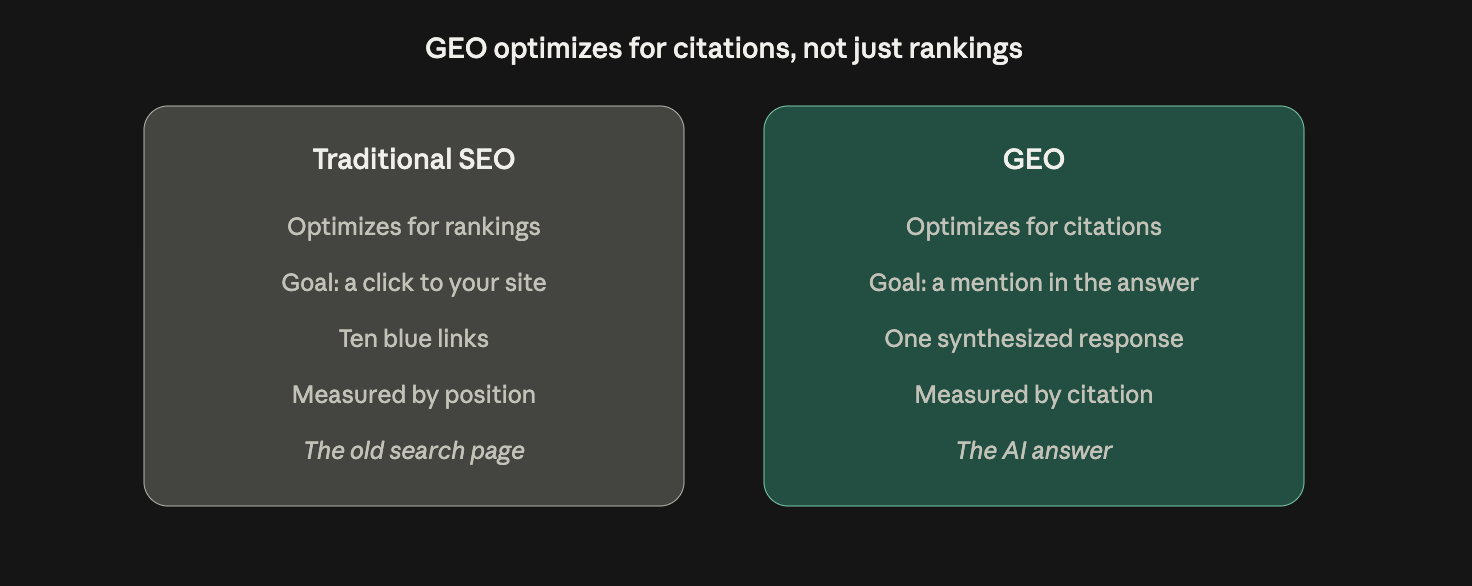
The distinction matters because the goal is different. SEO optimizes for traditional search engine rankings; the win is a high position and a click to your site. GEO optimizes for mentions and citations; the win is being named or quoted in an AI-generated answer, whether or not the user ever clicks through. As AI answers absorb more and more queries, appearing in that answer becomes as valuable as ranking once was. Google AI Overviews already appear on about 16% of searches as of November 2025, and that share is only climbing. Every one of those is a search where the AI answer, not the blue links, is what the user reads first.
For crypto specifically, this shift compounds an existing problem. Informational crypto content was already losing clicks to AI Overviews; GEO is how you turn that from a threat into a channel. Instead of losing the visitor to the AI answer, you become part of it.
How AI Engines Decide What to Cite
To optimize for AI citations, it helps to understand how AI search results are actually assembled, because it's not what most people assume.
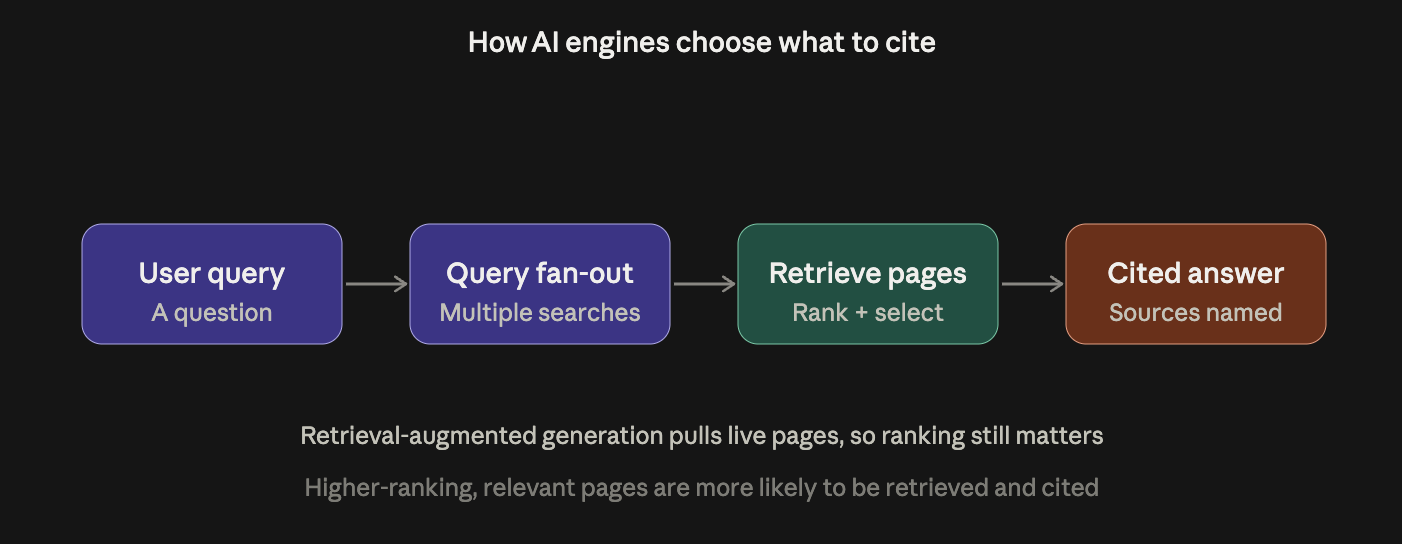
Modern AI answer engines don't just recite training data. They use retrieval-augmented generation, which means that when a user asks a question, the system runs live searches, retrieves current pages from the web, and uses those retrieved pages to construct its answer. Many engines also use query fan-out, breaking a single user's query into several related searches to gather a wider range of sources before composing a response.
This has a crucial implication: your existing content and your search rankings still matter enormously for GEO. Because AI engines retrieve live pages, the content that ranks well is the content most likely to be retrieved and cited. The relationship is direct; pages ranking higher are more likely to be included in AI recommendations. GEO isn't a replacement for SEO, it's a layer on top of it. The pages the AI can find, rank, and trust are the pages it cites.
What AI Engines Favor
Once you understand that AI engines retrieve and select sources, the next question is what makes them pick one page over another. The data on this is increasingly clear.
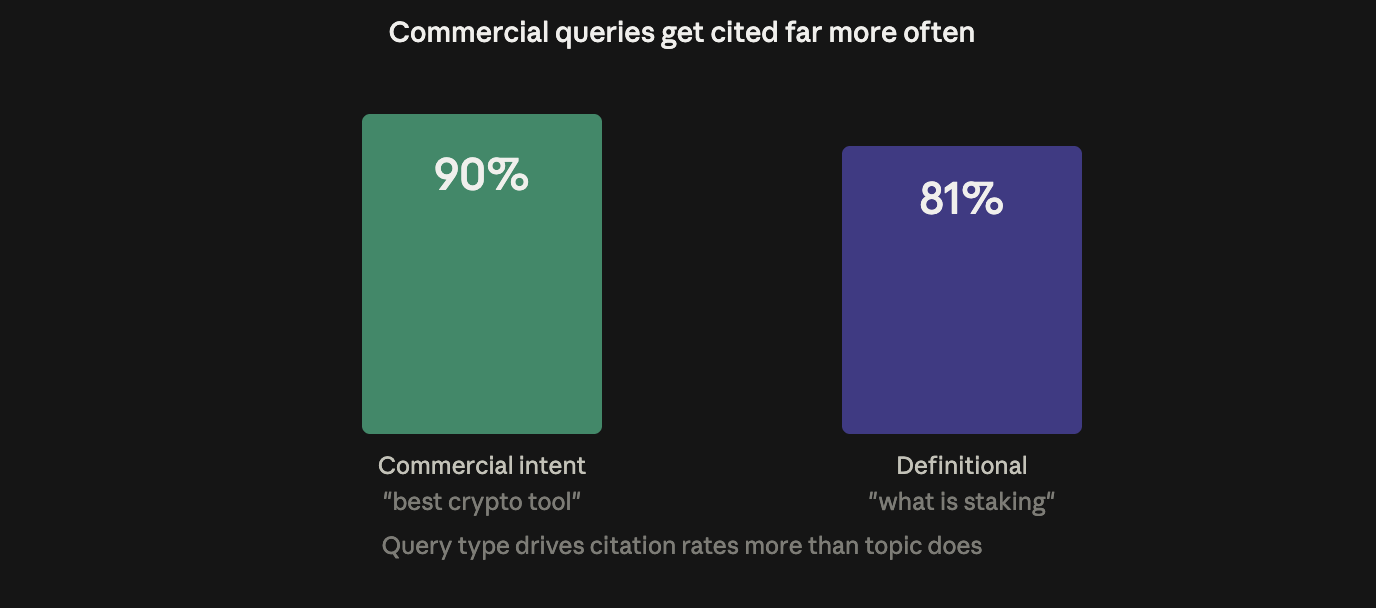
The single biggest factor is query type. AI citations are far more likely for commercial intent queries than for definitional ones. Commercial intent queries pull citations 90% of the time, while definitional queries cite sources only 81% of the time. Query type influences citation rates more than topic type does, which means a commercial crypto query ("best crypto analytics tool") is more likely to generate citations than a purely definitional one ("what is a blockchain"). For crypto projects, that's good news, because commercial and comparison content is exactly where business value lives.
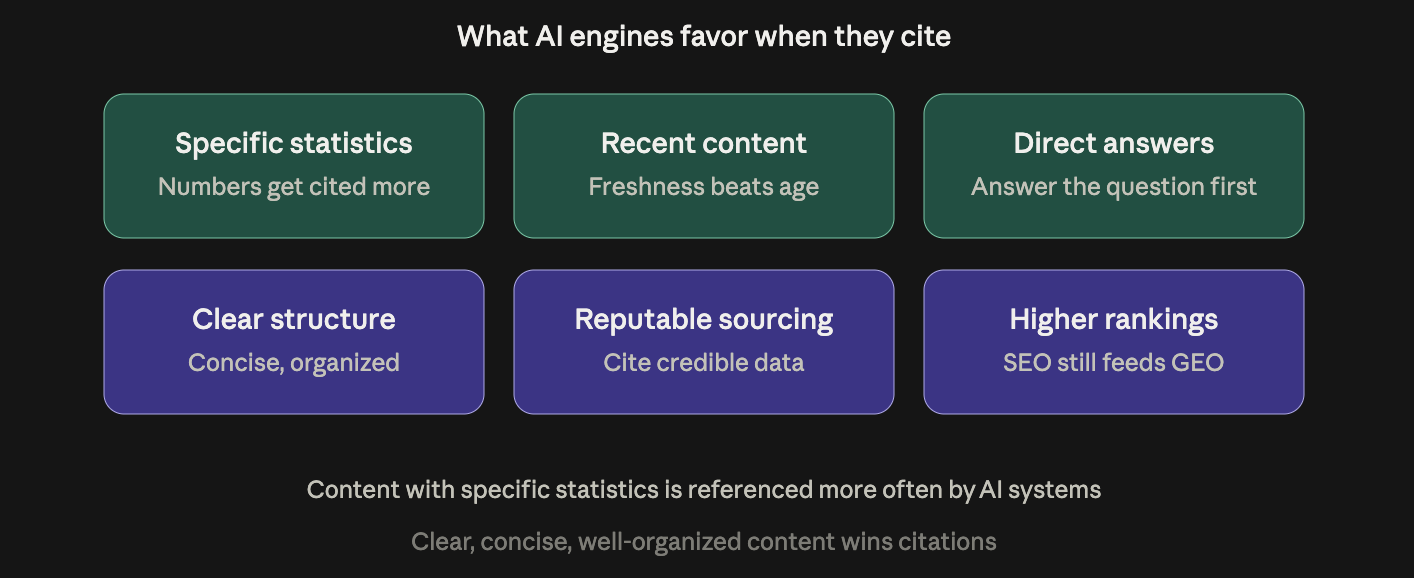
Beyond query type, several content signals consistently increase citation likelihood. Content with specific statistics is referenced more often by AI systems, so concrete numbers and data points make a page more citable than vague prose. AI systems prefer citing recent content over older material, which means freshness beats age even when the older content is high quality; keeping content up to date is a genuine ranking factor for AI. AI systems favor content that answers questions directly, rewarding pages that lead with the answer rather than burying it. And they prefer clear, concise, and organized content that's easy to parse and extract from. Using schema markup improves AI visibility by making your content machine-readable.
There's one more signal worth naming for anyone who thinks GEO lets them skip the SEO fundamentals: rankings still feed citations. Even pages ranking lower than position 21 get cited by some AI engines a surprising amount of the time, but the pattern overall is that higher-ranking, relevant, well-structured pages get pulled into answers most often. The foundations don't go away; GEO just adds a new reason to get them right.
How to Structure Crypto Content for AI Citation
Knowing what AI engines favor, the practical work of GEO is structuring content so it's as easy as possible for an AI to extract and cite. This is where GEO gets concrete.
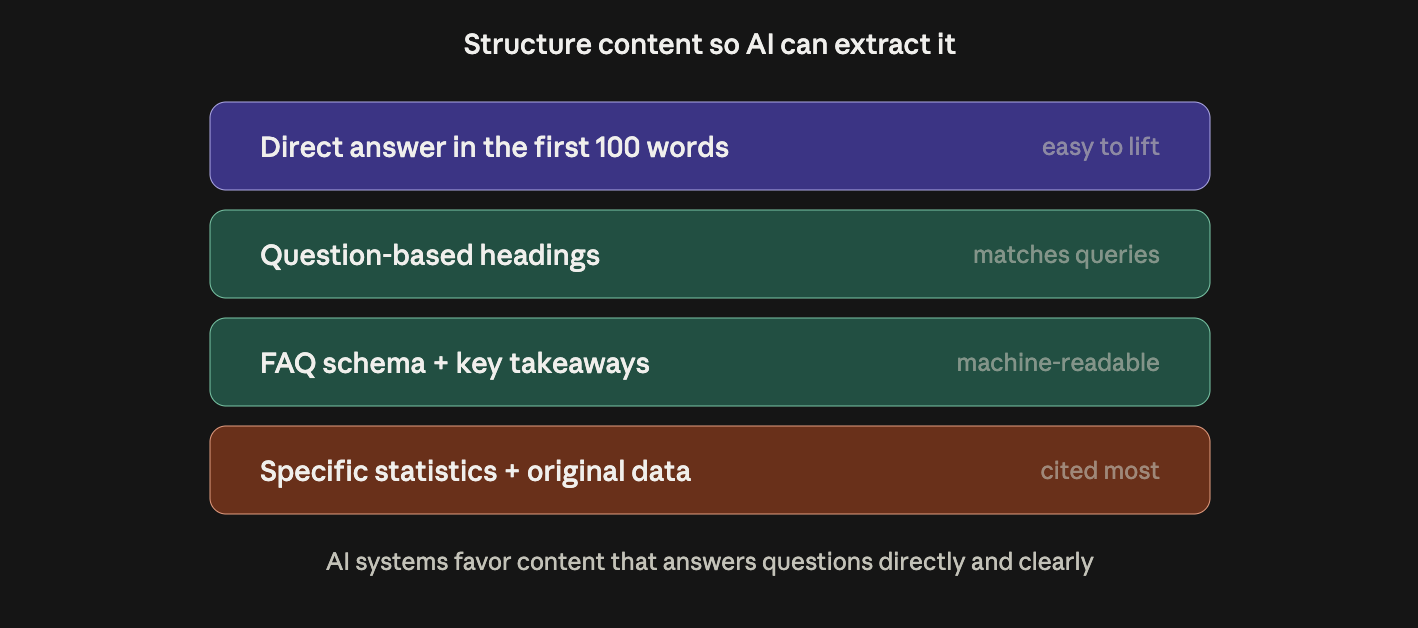
Lead with the answer. AI systems favor content that answers the question directly, so put a clear, quotable answer to the page's core question in the first hundred words. If your article is about what a crypto marketing funnel is, define it plainly at the top rather than making the reader, or the AI, wade through preamble to find it. The easier a statement is to lift cleanly, the more likely it gets lifted.
Use question-based headings. Structuring your headings as the questions users actually ask makes it easy for an AI to match your section to a query and pull the relevant part. Headings like "How does GEO work?" map directly onto how people phrase questions to AI engines.
Add FAQ schema and key takeaways. FAQ schema turns your questions and answers into machine-readable structured data that AI engines can parse directly. A short key-takeaways block near the top gives the AI a pre-summarised version of your content that's easy to cite. Both make your content more extractable without changing what a human reader sees.
Include specific statistics and original data. This is one of the highest-leverage GEO techniques, because content with specific statistics is cited more often, and original data is even better. If you can publish numbers nobody else has, whether that's proprietary research, survey results, or data from your own platform, you create citation opportunities that don't exist anywhere else. Common knowledge gets paraphrased; original data gets cited by name. For a crypto project sitting on unique on-chain or usage data, this is an enormous and underused advantage.
GEO Extends Beyond Your Own Site
Here's where GEO diverges most sharply from on-page SEO. AI engines don't only cite your website; they draw on the whole web when they decide what your project is and whether to mention it.
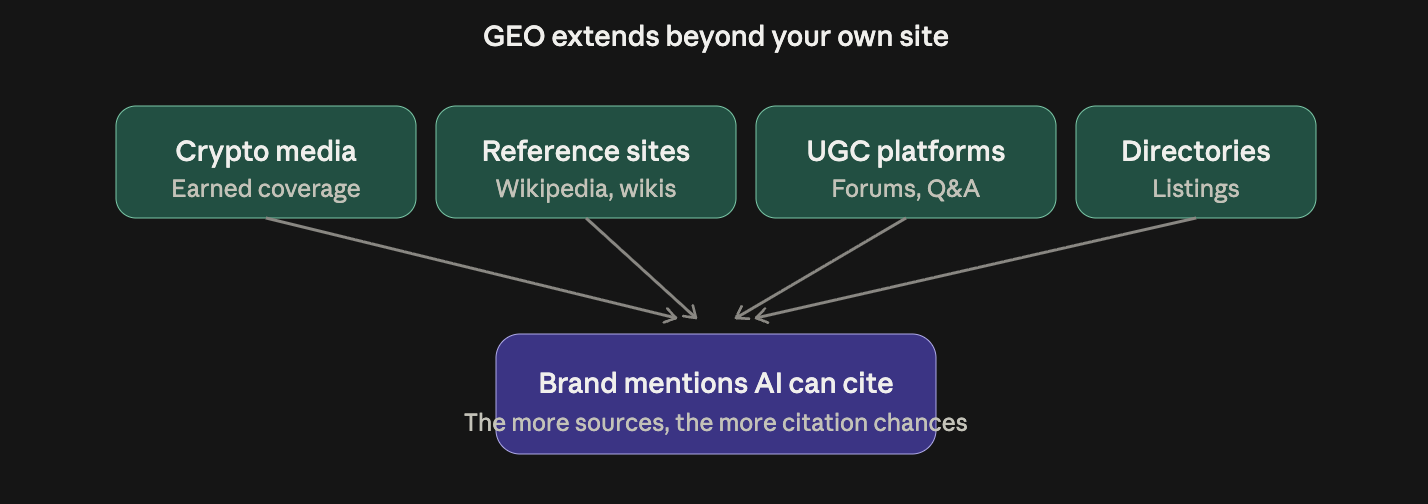
The more your project is mentioned across reputable sources, the more likely an AI is to reference it, because AI systems build their understanding of any topic from many places at once. That means citation opportunities exist far beyond your own pages. Earned coverage in reputable crypto media puts your project in sources AI engines already trust. Presence on reference sites like Wikipedia carries significant weight, since these are among the most heavily cited sources in AI answers. Mentions on UGC platforms like forums and Q&A sites feed into what AI models know, and these platforms are cited more than many projects realise. Listings in credible directories add further mentions the AI can draw on.
The strategic takeaway is that GEO and off-page reputation building are deeply linked. The same media relationships and brand mentions that build authority for SEO also expand the range of sources an AI can cite when your niche comes up. Getting your project mentioned, accurately and consistently, across a wide range of credible places is one of the most effective long-term GEO investments there is. It's also where GEO connects back to broader marketing: earned media and reputation work pay off twice, once for human trust and once for AI visibility.
GEO and SEO Are One Strategy
The most important thing to understand about GEO is that it isn't a separate discipline you bolt on after SEO. It's the same foundation viewed through a new lens. Both reward trust, clarity, recency, and authoritative sourcing. The content that ranks well tends to get cited well, because both systems are trying to surface the most credible, relevant answer to a question.
What GEO adds is a set of specific habits: leading with direct answers, structuring content around real questions, including hard statistics and original data, marking content up with schema, and building mentions across the wider web. None of these hurt your traditional SEO; all of them help it. Optimizing for AI is, in practice, optimizing for good content that's clearly structured and genuinely authoritative, which is what search always rewarded anyway.
For crypto projects, the opportunity is unusually open. AI search optimization is still a largely untapped channel, most competitors haven't adapted, and the projects that structure their content for citation now will be the ones AI engines reach for as this shift accelerates. The window where GEO is a genuine edge rather than table stakes won't stay open forever.
Getting Started With GEO
GEO rewards projects that act early. Structure your most important content to answer questions directly, add the statistics and original data that make pages citable, mark up your content with schema, keep it current, and build accurate mentions of your project across the credible sources AI engines already trust. Layer that onto solid SEO foundations and you're optimising for both how people search today and how they'll search tomorrow.
The projects that win AI visibility won't be the ones with the biggest budgets. They'll be the ones whose content is the clearest, best-sourced, most current answer to the questions their audience is asking, structured so an AI can find it and quote it.
Getting cited in AI answers is quickly becoming as important as ranking in Google, and the projects that move first will own the space while competitors are still catching up. At GrowthChain, we help crypto projects build GEO and SEO strategies that get them found in search and cited in AI, from content structure and original data to the media presence that AI engines draw on. If you want your project to be the one AI recommends, get in touch with our team and let's make you citable.
Frequently Asked Questions
What is generative engine optimization (GEO)?
GEO is the practice of optimizing content so that AI search engines like ChatGPT, Perplexity, and Google AI Overviews reference it when generating answers. Where SEO optimizes for search rankings and clicks, GEO optimizes for mentions and citations inside AI-generated answers.
How is GEO different from SEO?
SEO aims to rank your page in a list of search results so users click through. GEO aims to get your content cited inside the single answer an AI generates, whether or not the user clicks. They share the same foundations and are best treated as one integrated strategy.
How do AI engines decide what to cite?
Most AI answer engines use retrieval-augmented generation, running live searches and pulling current web pages to build their answers. Higher-ranking, recent, well-structured pages with specific statistics and clear direct answers are the most likely to be retrieved and cited.
What content gets cited most by AI?
Content answering commercial-intent queries is cited around 90% of the time, more than definitional content. AI systems also favour content with specific statistics, recent publication dates, direct answers near the top, clear structure, and schema markup.
Does SEO still matter for GEO?
Yes. Because AI engines retrieve live pages to build answers, the content that ranks well is the content most likely to be cited. Strong SEO foundations directly improve GEO performance, so the two work together rather than replacing one another.
How can crypto projects improve their GEO?
Lead with direct, quotable answers, use question-based headings, add FAQ schema and key takeaways, include specific statistics and original data, keep content current, and build accurate mentions of your project across reputable media, reference sites, and directories that AI engines already trust.

From The Blog
You may also like




Stop Guessing. Start Scaling.
Data-driven crypto marketing that actually delivers users, not vanity metrics.

GrowthChain is a disruptive web3 marketing agency looking to propel your customer base. We focus on DAOs, DeFi, NFT and Crypto projects.

GrowthChain Designed, 2025
.svg)