






Crypto Backlinks & Negative SEO Recovery
Backlinks are one of the oldest ranking signals in search, and in crypto they’re also one of the most consequential. In a niche Google treats as Your Money or Your Life (YMYL), where trust is the deciding factor, the crypto websites that other credible sites link to are the ones that rank. A crypto project with a strong backlink profile outranks a better-funded competitor with a weak one, over and over.
But crypto backlinks come with a problem most industries never have to think about. The same space is full of spammy links, manipulation, and outright attacks, which means crypto link building here isn’t just about earning good links. It’s also about defending against bad ones that other people point at your site on purpose. This guide covers both halves: how to build quality crypto backlinks that lift your rankings, and how to spot and neutralise a negative SEO attack when it comes, drawn from an attack we dealt with ourselves.
It builds on our complete crypto SEO guide, where off-page authority is one pillar among four; here we go deep on links, both earning them and protecting against them.
Part One: Building Quality Crypto Backlinks
Why backlinks still matter
Backlinks act as trust votes. When another website links to yours, it’s telling search engines that your site is credible enough to reference, and search engines rely on backlink profiles to judge a site’s authority and domain authority. In crypto, where Google’s YMYL standards demand high levels of experience, expertise, authoritativeness, and trustworthiness, those votes carry even more weight. Backlinks from established publications signal that your project is recognised by industry peers, and higher-authority links directly improve your rankings for competitive target keywords.
They also do more than lift rankings. Relevant links from crypto publications send referral traffic, real visitors who are already interested in the space and more likely to care about what you do. A single well-placed editorial link on a reputable crypto site can deliver both ranking authority and qualified visitors at once, which is why building links is one of the highest-return marketing channels available to crypto businesses.
Quality beats quantity, every time

The most important principle in crypto link building is that link quality beats quantity, decisively. A few high-authority, relevant, editorial links do more for your rankings than hundreds of low-quality ones, and spammy backlinks can actively hurt you. Links from reputable crypto sites, placed naturally within genuine content, are what move the needle. Links bought in bulk from thin or irrelevant sites signal manipulation and risk a penalty.
Relevance matters as much as authority. A link from a respected crypto or blockchain site is worth far more than one from an unrelated high-traffic site, because search engines assess relevance alongside authority. The goal is a profile of relevant links that look, and are, genuinely earned.
The tactics that actually earn links

There’s no single link building strategy that works alone, but a handful of approaches consistently earn high quality backlinks for crypto websites.
Guest posting remains one of the most reliable. Writing genuinely useful articles for authoritative crypto blogs and news sites earns editorial links while putting your expertise in front of new audiences. The key is to prioritise editorial quality and relevance over cheap, mass-submitted posts; a single guest post on a respected site is worth more than a dozen on low-quality ones.
Linkable assets attract links passively once they exist. These are pieces of link worthy content so useful that other websites reference them naturally: tools, in-depth guides, calculators, and infographics that solve a real problem in the crypto community. A genuinely useful converter tool or data resource can attract tens of thousands of backlinks over time without any ongoing outreach, because people link to it on their own. Backlinks from crypto SaaS platforms are especially valuable here, since they signal real industry integration. Infographics in particular simplify complex blockchain ideas into something shareable, which makes them natural link magnets across social media platforms and crypto blogs alike.
Digital PR and original research earn the highest-authority links of all. Publishing original market analysis, adoption data, or research that journalists want to cite generates links from top news outlets, the kind of coverage that both ranks and builds reputation. This is where keyword research and trend tools feed the work directly: checking Google Trends and your target keywords before you publish helps you build research around topics the crypto world is already searching for, which is what makes journalists and crypto bloggers pick it up. Newsworthy updates, unique partnerships, and a well-timed press release announcing a significant development all attract links from crypto news sites. Collaborating directly with industry journalists turns into citations and links over time.
Unlinked brand mentions are often the easiest wins available. These are places where someone has referenced your project by name without linking to it. Finding them is as simple as searching for exact-match mentions of your brand, and most site owners are happy to add a link when you politely ask. For an established crypto startup, there can be thousands of these waiting to be converted.
Broken link building replaces dead links on relevant sites with your own content. In the fast-moving crypto industry, pages disappear constantly, leaving broken links behind. Finding those dead links on relevant sites and suggesting your existing content as a replacement helps the site owner fix a problem while earning you a link. Tools like Ahrefs make finding broken links straightforward.
Directories, resource pages, and link roundups round things out. Getting listed in reputable crypto directories, featured on relevant resource pages, and included in link roundups adds credible, relevant crypto placements while improving your discoverability. Editorial link insertions, where a site adds a link to your content within an existing, relevant article, are another clean way to earn placements when the fit is genuine.
Keep your anchor text diverse

One technical point underpins all of this: diversify your anchor text to maintain link diversity. Anchor text is the clickable text of a link, and search engines watch its pattern closely. A natural backlink profile has varied anchors, your brand name, your URL, natural phrases, and only occasionally an exact-match keyword. A profile where the same keyword-rich anchor repeats across hundreds of links looks manipulative and can trigger spam penalties. Earned links naturally produce diverse anchors; manufactured ones often don’t, which is exactly why repetitive anchors are a red flag to search engines. Keep it varied and it stays safe.
Links are one factor, not the only one
It’s worth a brief reminder that backlinks don’t work in isolation. A strong backlink profile amplifies a site that’s already technically sound, but it can’t rescue one that isn’t. On-page SEO, solid technical SEO, and good website speed all have to be in place for links to do their job, since search engines won’t reward authority pointing at a site they can’t crawl or that frustrates users. Think of links as the authority layer on top of a healthy foundation, not a substitute for one. Our complete crypto SEO guide covers how those pieces fit together.
Part Two: Defending Against Negative SEO
Here’s the part most crypto SEO strategy guides skip, because most people writing them have never had to deal with it. We have. And in crypto, it’s not rare.
What negative SEO is
Negative SEO is when someone deliberately points toxic, spammy links at your site to harm your rankings. Instead of building bad links to their own site, an attacker builds them to yours, trying to make it look like you’re running a spam link scheme so that search engines penalise you. You didn’t build these links. Someone else did it to you, on purpose.
It’s more common in crypto than in almost any other niche, because the space is competitive, adversarial, and full of actors willing to play dirty. If your crypto site starts ranking well, there’s a real chance someone eventually tries this.
How to spot an attack
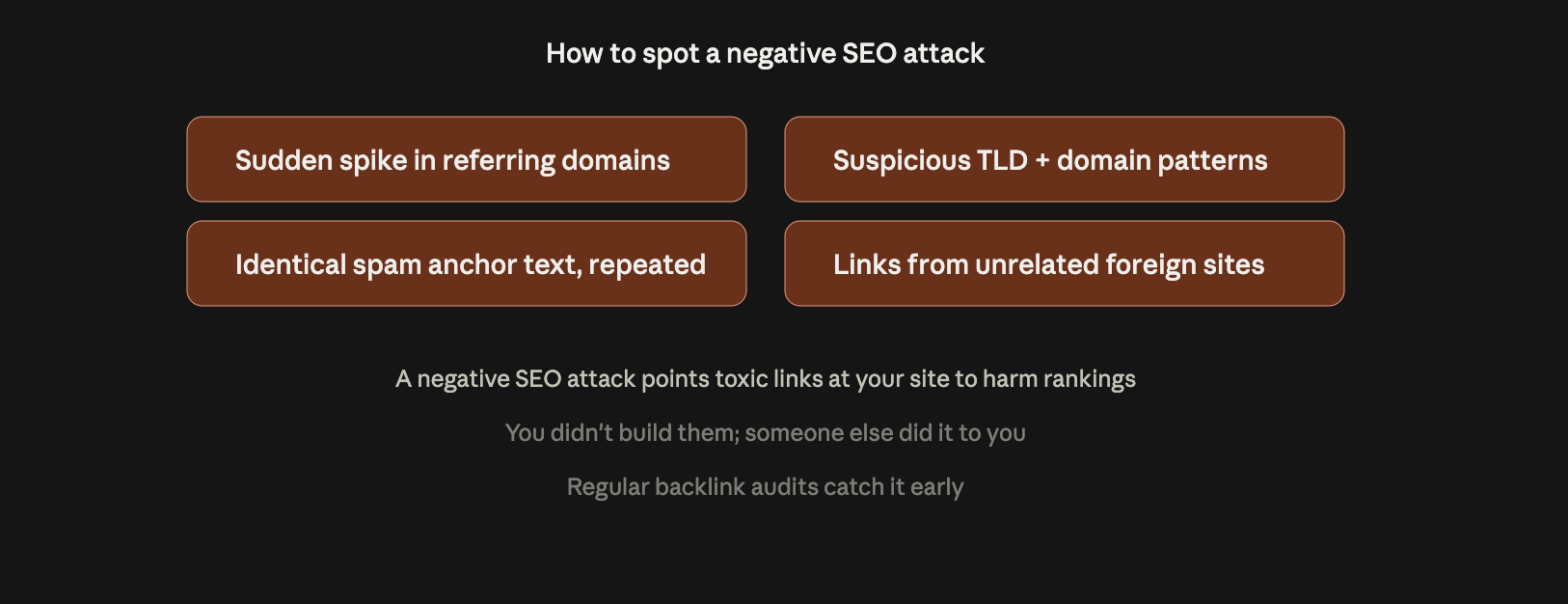
The good news is that negative SEO attacks follow recognisable patterns, and if you’re watching your backlink profile, you’ll catch them. The warning signs are consistent.
The first is a sudden, unexplained spike in referring domains, far more links appearing than your actual activity would produce. The second is identical spam anchor text, the same phrase repeated across hundreds of links, often promotional or in another language, with nothing to do with your brand. The third is suspicious domain and TLD patterns, large numbers of links from cheap, bulk-registered domains that share an obvious naming structure. The fourth is a flood of links from unrelated foreign sites with no logical reason to reference a crypto project.
When several of these appear together, you’re almost certainly looking at an attack rather than organic growth. This is exactly why regular backlink audits matter; the sooner you catch it, the easier it is to contain.
A real attack we handled

We’ve been through this directly, so this isn’t theory. On a crypto project we worked on, a backlink audit surfaced hundreds of toxic links that nobody on our side had built. They carried identical spam anchor text, promotional phrases pointing to a messaging channel, repeated over and over. And they came from a clear network of throwaway domains that all followed the same structure: the same base name with a rotating list of cities, spread across a handful of cheap top-level domains.
Once we recognised the pattern, the response was methodical.
First, we audited the full backlink profile and exported every referring domain, so we could see the whole attack rather than a sample of it. Second, we identified the pattern precisely, mapping out the naming structure and the TLDs the attacker was cycling through, which let us account for variants that hadn’t even been indexed yet. Third, we built a complete disavow file, listing the toxic domains at the domain level rather than URL by URL, since disavowing a whole spam domain catches every bad link from it at once. Fourth, we submitted that file to Google Search Console, telling Google to ignore those links when assessing the site.
One detail worth knowing if you ever do this: Google replaces your disavow file on each upload rather than merging it. So the file you submit has to be complete, containing everything you’ve ever disavowed plus the new additions, or you’ll accidentally un-disavow your earlier work.
The result
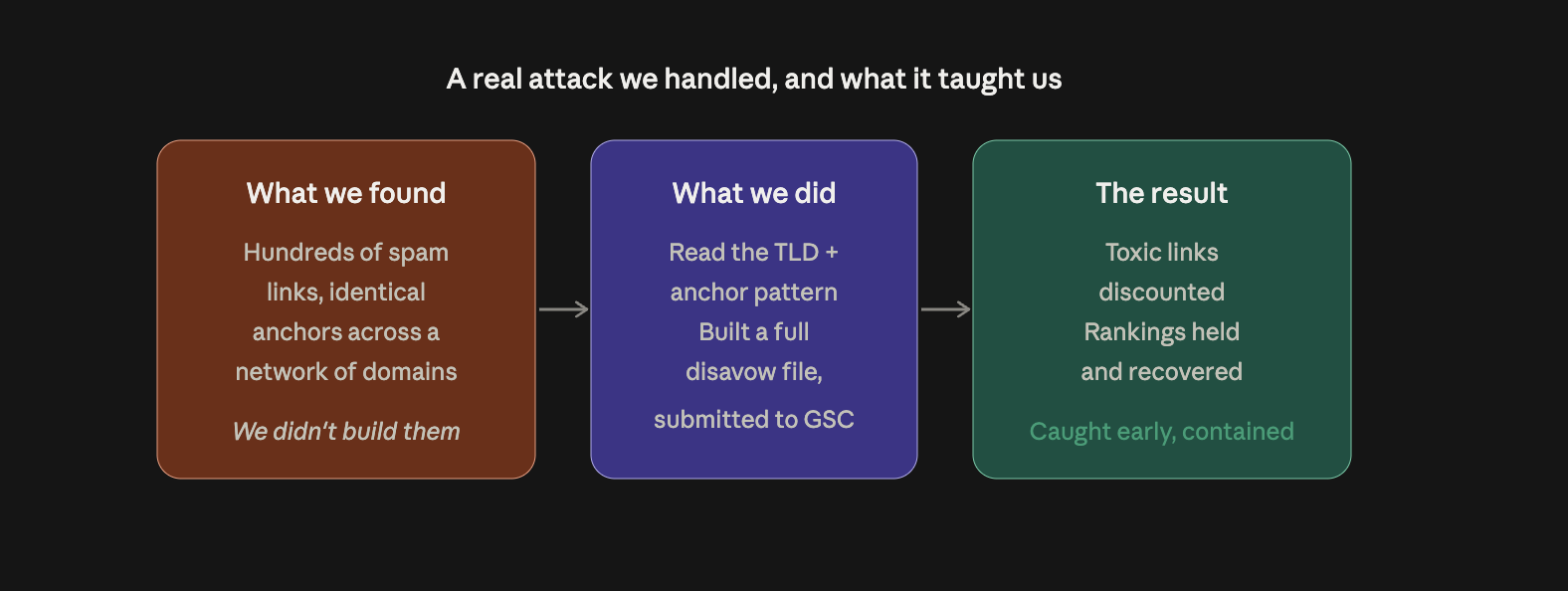
The outcome was reassuring, and it’s worth knowing for anyone facing the same thing. Most of these attack links were nofollow, which search engines already discount, so the direct ranking damage was limited from the start. The disavow added a layer of protection on top, explicitly telling Google to disregard the toxic network even if any follow links slipped through. Because we caught it early through routine auditing, the attack was contained before it could do lasting harm, and rankings held and recovered.
The lesson from the whole episode is simple: negative SEO in crypto is real, but it’s survivable if you’re watching for it. The projects that get hurt are the ones not monitoring their backlink profile and so never notice the attack until the damage is done. The ones that audit regularly spot the pattern, disavow it, and move on.
Build a monitoring habit
The defence against negative SEO isn’t a one-time action; it’s a habit. Audit your backlink profile regularly so a sudden spike or a suspicious pattern gets caught quickly. Keep an eye on referral traffic in Google Analytics too, since an unexplained shift can be an early hint that something has changed in your link profile. Keep your disavow file current and complete, so that when you do need to add to it, you’re building on everything that came before. And treat a clean, well-monitored backlink profile as part of your ongoing crypto SEO work, not something you only look at when something goes wrong.
Links Are an Asset Worth Protecting
Crypto backlinks are one of the most valuable assets a project can build, and like any valuable asset, they’re worth both growing and protecting. On the building side, focus on quality over quantity, earn links through genuinely useful content and real relationships, and keep your anchor text diverse. On the defensive side, watch your backlink profile, recognise the signs of a negative SEO attack, and know how to disavow toxic links when they appear.
Do both, and your backlink profile becomes a durable source of authority and referral traffic that competitors can’t easily match, and that an attacker can’t easily damage. Ignore either side, and you leave rankings on the table or exposed to harm.
Building quality crypto backlinks and defending against negative SEO both take experience, and the stakes in this niche are higher than most. We help crypto projects build authoritative backlink profiles through real link building and digital PR, and we know how to spot and shut down negative SEO attacks because we’ve done it. If you want your project’s authority built and protected, get in touch with our team and let’s strengthen your backlink profile.
Frequently Asked Questions
Do backlinks still matter for crypto SEO?
Yes. Backlinks remain one of the strongest ranking signals, and in crypto’s YMYL niche they carry extra weight because they act as trust votes. High-quality links from reputable crypto sites directly improve rankings for competitive keywords and drive qualified referral traffic.
How do you build quality crypto backlinks?
Earn them through guest posting on authoritative crypto media, creating linkable assets like tools and infographics, publishing original research and digital PR, converting unlinked brand mentions into links, broken link building, and getting listed in reputable directories, resource pages, and link roundups. Prioritise quality and relevance over volume.
What is negative SEO?
Negative SEO is when someone deliberately points toxic backlinks at your site to harm its rankings, trying to make it look like you’re running a spam link scheme so search engines penalise you. It’s more common in crypto than most niches because the space is highly competitive.
How can I tell if I’m under a negative SEO attack?
Watch for a sudden spike in referring domains, identical spam anchor text repeated across many links, suspicious domain and TLD patterns from bulk-registered sites, and a flood of links from unrelated foreign sites. Several of these together usually indicate an attack.
How do I disavow toxic backlinks?
Audit your backlink profile and export the links, identify the toxic pattern, build a disavow file listing the bad domains at the domain level, and submit it to Google Search Console. Remember that Google replaces your disavow file on each upload, so always submit a complete file.
Does negative SEO actually hurt crypto rankings?
It can, but the impact is often limited because many attack links are nofollow, which search engines already discount. Catching an attack early through regular backlink audits and disavowing the toxic links contains the damage. Projects that monitor their profiles rarely suffer lasting harm.

From The Blog
You may also like




Stop Guessing. Start Scaling.
Data-driven crypto marketing that actually delivers users, not vanity metrics.

GrowthChain is a disruptive web3 marketing agency looking to propel your customer base. We focus on DAOs, DeFi, NFT and Crypto projects.

GrowthChain Designed, 2025
.svg)