






Most crypto projects don't fail because the product is weak. They fail because nobody knows it exists. And the reason nobody knows is almost always the same: there was never a real crypto marketing plan, just scattered posts, a rushed influencer deal, and a launch that came and went.
A crypto marketing plan fixes that. It turns a vague intention to "do crypto marketing" into a clear sequence of objectives, audiences, channels, budget, and timeline. It forces you to decide what you're trying to achieve before you spend on achieving it, which is exactly what separates the crypto projects that build momentum from the ones that stall.
This guide walks through how to build one, section by section, and gives you a crypto marketing plan template you can copy for your own crypto business. For the strategic thinking behind it, our ultimate crypto marketing strategy guide covers the why; this article is the how.
What Is a Crypto Marketing Plan?
A crypto marketing plan is a structured document that defines how a project will build awareness, trust, and demand across the crypto industry. It sets out the marketing objectives, identifies the target audience, selects the marketing channels, allocates the marketing budget, and lays it onto a timeline with clear KPIs.
A marketing plan for a cryptocurrency product requires both traditional marketing and crypto-specific marketing strategies, which is where crypto marketing differs from a standard consumer plan. You're planning community building alongside content marketing, on-chain analytics alongside traditional metrics, and doing all of it inside a regulatory framework that shapes what you can say.

The plan has five core sections, and each feeds the next. Your objectives determine your audience focus. Your audience determines your channels. Your channels determine your budget. And your budget plays out across your timeline. Get them in order and the plan builds itself.
Section 1: Define Your Marketing Objectives
Everything starts with objectives. Not "grow the crypto community" or "get more users," but specific, measurable goals that tell you whether the plan is working.
Why vague goals kill plans
The problem with vague marketing objectives is that you can't tell if you've hit them. "Build awareness" has no finish line. "Reach 5,000 active wallets within 90 days of launch" does. The second tells you what to do, how much to spend, and whether it worked. This is where the best crypto marketing strategies start: with a number.

Apply the SMART framework
The cleanest way to write effective crypto marketing strategies is to make each one specific, measurable, achievable, relevant, and time-bound. Define measurable objectives like active wallets and engagement rates rather than soft targets like "more visibility." A good objective reads like a sentence with a number and a deadline in it.
For most crypto projects, the primary objectives fall into a few buckets: community growth, user acquisition, awareness, and conversion. Pick one or two as primary rather than chasing all at once. A plan that tries to maximise everything usually achieves nothing.
Section 2: Identify Your Target Audience
You can't market to everyone, and in the crypto space, trying to is a fast way to resonate with no one. The second section of your crypto marketing plan defines exactly who you're building for.
Build a specific target market
The more specific your target market, the easier every other decision becomes. A project targeting DeFi power users makes different channel choices than one targeting first-time crypto users. Define your audience by what they already do, where they already spend time, and what problem your project solves for them.
Market analysis matters here. Understanding trends and regulatory considerations is crucial in blockchain market analysis, and the same research that shapes your product should shape who you market it to. Look at user behavior on comparable crypto companies, the online forums and communities they gather in, and the language they use.
Map your competitive landscape
Competitor analysis involves identifying direct and indirect competitors in the blockchain space. You're not copying them; you're finding the gap they've left open. Positioning statements define what a project does and how it differs from competitors, and that difference is what your target audience will remember in a crowded market.
Section 3: Choose Your Marketing Channels
With objectives and audience set, the marketing channels almost pick themselves. This is where most of the plan's day-to-day activity lives.
Group channels by what they do
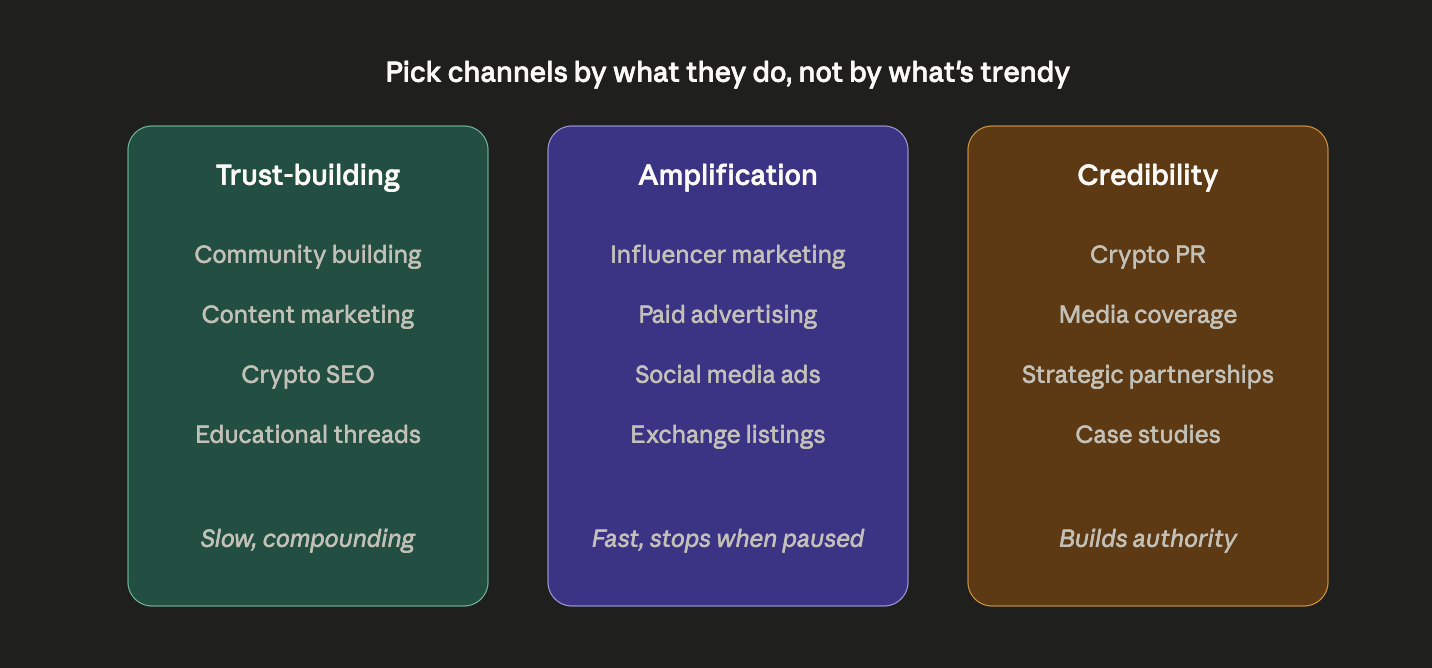
The mistake most crypto companies make is choosing channels by what's trendy rather than by function. Group them instead. Some channels build trust slowly and compound over time. Others amplify quickly but stop the moment you stop paying. A third group builds credibility through third parties.
Community building, content marketing, and search engine marketing are your trust-building channels. They're slow to start and compound for years. Content marketing helps explain the technology and build authority in the blockchain space, and SEO enhances visibility for crypto-related websites so the right people find you through search. Blogs and videos are effective content types, and content should educate and entertain to resonate with crypto enthusiasts.
Influencer marketing, paid advertising, and social media advertising are your amplification channels. Influencer marketing uses trusted crypto influencers to raise awareness, and influencer partnerships can resonate with target audiences far more effectively than brand-owned channels alone. Ambassador programs establish long-term relationships with influencers, while sponsored content involves paying influencers to promote your project for a defined campaign. These move fast but need the trust-building layer underneath them to convert.
Crypto PR and strategic partnerships are your credibility channels. Public relations builds trust by getting your project covered by sources your audience already believes, and transparency in PR enhances perceived authenticity.
Match channels to your audience
The channels you pick should follow directly from the audience section. If your target market lives in Discord and reads technical threads, that's where your effort goes. If they're discovering crypto through search and YouTube, weight content marketing and influencer partnerships. Don't spread across every channel; pick the few where your specific crypto audience actually is.
Section 4: Set Your Marketing Budget
A plan without a budget is a wish list. This section turns your channel choices into a spending allocation.
Allocate by stage, not evenly
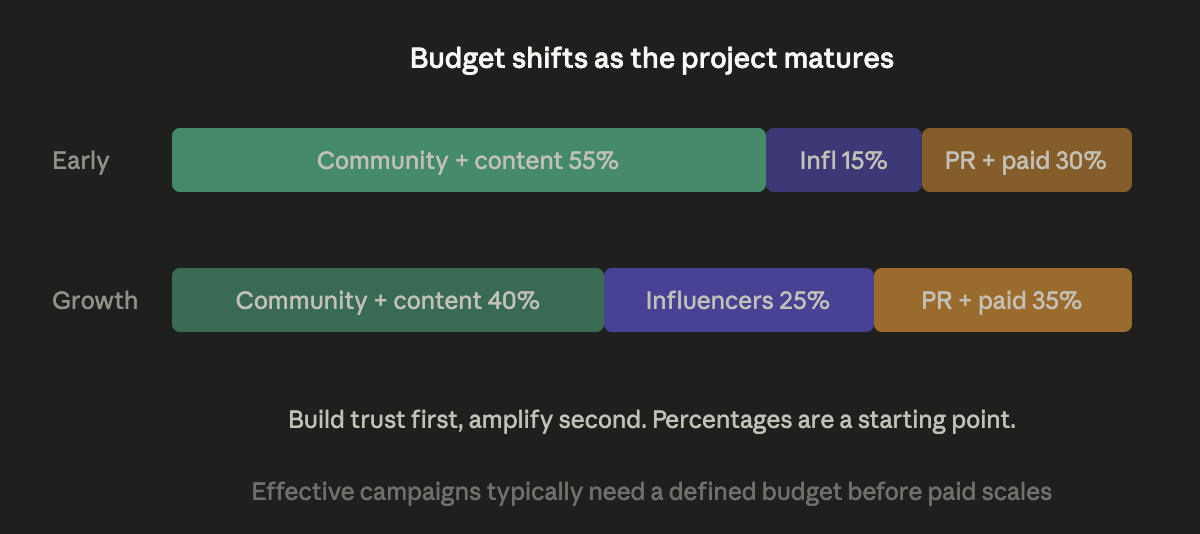
The single most useful budgeting principle in crypto marketing is to weight your spend toward trust-building early and shift toward amplification as you mature. Early stage projects should put the majority of the budget into community and content, because paid campaigns rarely convert before a brand is established. Growth stage projects shift more toward influencer marketing and paid advertising once that foundation exists.
Effective campaigns require a defined budget before paid advertising scales. Decide your total, split it across your channel groups, and hold some back. A reserve for post-launch is what separates projects that sustain momentum from those that go quiet a month after going live.
Track what the budget returns
Budget allocation isn't set and forget. Measuring success in paid advertising includes metrics like cost per click and click-through rate, and successful campaigns require both digital and on-chain analytics. Tie every meaningful line of ad spend to a metric so you know what to cut and what to double down on.
Section 5: Build Your Timeline and KPIs
The final section places everything onto a calendar and defines how you'll measure it.

Sequence the work
A timeline forces sequencing, and sequencing is where good plans separate from good intentions. A simple 90-day structure works well for most launches: a foundation phase, a momentum phase, and a scale phase. Each phase has a clear focus, and each builds on the one before it. For projects that want to test quietly first, a stealth mode period before the foundation phase allows private product testing before public launch, and a coordinated blitz at launch can create immediate buzz and FOMO.
Define your KPIs
Key performance indicators monitor community growth rate, website traffic, and conversion rates. For crypto specifically, track wallet creation and transaction volume alongside the traditional metrics, and measure conversion rates against figures like customer acquisition cost and lifetime value. Use analytics tools that combine on-chain and off-chain data so you're measuring real engagement, not just impressions or follower counts.
Set a review point at each phase boundary. Check the numbers, decide what's working, and reallocate. A plan you revisit every 30 days will outperform a perfect plan you write once and never open again.The Crypto Marketing Plan Template
Copy the structure below and fill in each section for your own project. This is the working template; everything above is the explanation of how to use it.
The Crypto Marketing Plan Template
Section 1: Marketing Objectives
Define 2 to 3 measurable goals, each with a number and a deadline.
Example: Reach 5,000 active wallets within 90 days of launch. Grow Discord to 2,000 engaged members before TGE. Achieve a 30% wallet-connection rate from campaign traffic.
→ Your objectives:
Section 2: Target Audience
Describe exactly who you're building for, where they spend time, and what problem you solve.
Example: DeFi power users active in Discord and on Crypto Twitter, frustrated by high fees on existing platforms.
→ Your primary audience:
→ Where they gather:
→ Your positioning statement (what you do and how you differ):
→ Top 3 competitors and the gap you fill
Section 3: Marketing Channels
List the channels you'll use, grouped by function. Pick the few that match your audience.
Trust-building (community, content, SEO):
Amplification (influencers, paid, social ads):
Credibility (PR, partnerships):
→ Your channel mix
Section 4: Marketing Budget
Set a total, then split it across your channel groups by stage.
Example (early stage): Community + content 55%, influencers 15%, PR + paid 30%, with a 15% post-launch reserve.
→ Total budget:
→ Allocation by channel group:
→ Post-launch reserve
Section 5: Timeline and KPIs
Lay the plan across a timeline and define how you'll measure each phase.
Days 0–30 (Foundation):
Days 31–60 (Momentum):
Days 61–90 (Scale):
→ Your KPIs (community growth, wallet creation, traffic, conversion, CAC):
→ Review points
Putting the Plan to Work
A crypto marketing plan isn't a document you write once and file away. It's a working tool you revisit at every review point, adjusting allocation as the data comes in. The projects that win are rarely the ones with the biggest budget; they're the ones that planned the sequence, measured honestly, and moved spend toward what was working.
Start with the objectives, let each section flow into the next, and fill in the template above. Once it's built, the day-to-day marketing stops being a guessing game and becomes a list of things you already decided to do.
For the strategic thinking that sits behind each of these sections, the ultimate crypto marketing strategy guide goes deeper on the why behind the what.
For any help with web3 marketing strategy, contact us, crypto marketing agency: GrowthChain.
Frequently Asked Questions
What is a crypto marketing plan?
A crypto marketing plan is a structured document that defines a project's marketing objectives, target audience, marketing channels, budget, and timeline. It combines traditional marketing strategies with crypto-specific ones like community building and on-chain analytics.
What are the steps to create a crypto marketing plan?
There are five core steps: define measurable marketing objectives, identify your target audience, choose your marketing channels, set and allocate your marketing budget, and build a timeline with clear KPIs. Each step feeds into the next.
How do I write crypto marketing objectives?
Use the SMART framework: make each objective specific, measurable, achievable, relevant, and time-bound. Favour concrete metrics like active wallets, community engagement rates, and conversion over vague goals like "more awareness."
How should I allocate a crypto marketing budget?
Weight spend toward community and content early, since paid channels rarely convert before a brand is established. Shift toward influencer marketing and paid advertising as the project matures, and always keep a reserve for the post-launch phase.
What KPIs should a crypto marketing plan track?
Track community growth rate, website traffic, and conversion rates, plus crypto-specific indicators like wallet creation and transaction volume. Combine on-chain and off-chain analytics, and measure against cost per acquisition and lifetime value.
How long should a crypto marketing plan cover?
A 90-day plan split into foundation, momentum, and scale phases works well for most launches. Review KPIs at each 30-day mark and reallocate budget toward the channels that are performing.

From The Blog
You may also like


Stop Guessing. Start Scaling.
Data-driven crypto marketing that actually delivers users, not vanity metrics.

GrowthChain is a disruptive web3 marketing agency looking to propel your customer base. We focus on DAOs, DeFi, NFT and Crypto projects.

GrowthChain Designed, 2025
.svg)