






Most token launches look like a success for about a day. The countdown ends, the token starts trading, the announcements go out, and the chart climbs. Then attention moves on, early buyers take profit, and the team is left with a quiet Discord and a price that only moves one way.
The numbers back this up. An analysis by Memento Research tracked 118 token generation events from the year and found that 84.7% were trading below their TGE valuation. That is the default outcome in the current crypto market, and it rarely comes down to the technology. It comes down to how the launch was planned and marketed.
Token launch marketing is what separates the minority that hold their ground from the majority that don't. This playbook walks through it in order: when to start, what to do in each phase, how to split the budget, how to run launch day, and what to do in the 90 days after. It sits alongside our crypto marketing strategy guide, which covers the ongoing picture; here the focus is the launch itself.
What Is Token Launch Marketing?
Token launch marketing is the planned sequence of marketing activity that takes a token from unknown to traded, held, and used. It covers the pre launch phase, the token generation event, and the months that follow, and it treats all three as one continuous programme.
That continuity is the whole point. Effective marketing for a token requires a multi-phase growth process instead of a single promotional push, and each phase has a different job. Before the TGE you build awareness and a community that wants the token. On launch day you coordinate distribution, liquidity, and announcements so the first hours go cleanly. After the TGE you move the audience from speculation to product usage, because usage is the only thing that creates demand once the launch excitement fades.
If the bigger question is how your project enters the market at all, start with our guide to building a crypto go-to-market strategy. Token launch marketing is the part of that plan built around a single date.
Why Most Token Launches Lose Momentum
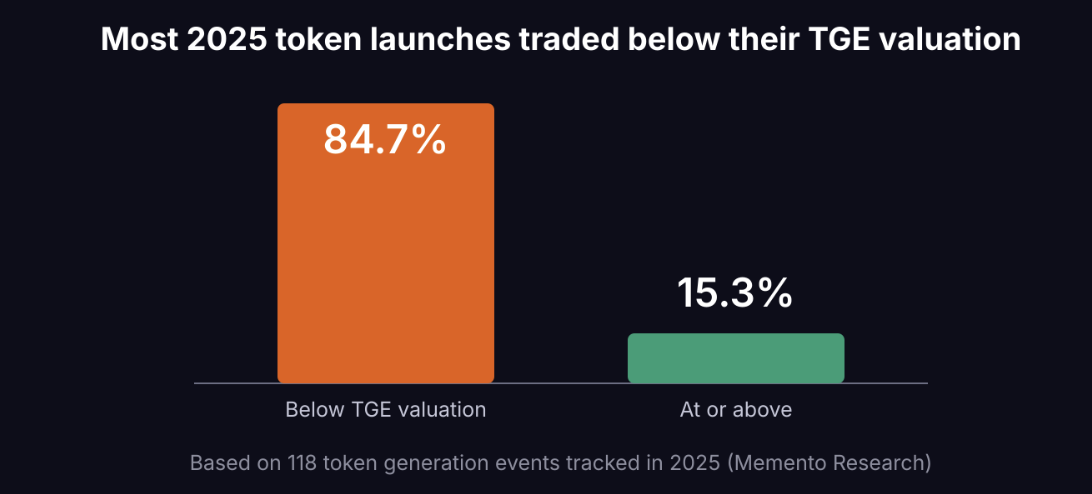
It's tempting to blame the market when a launch fades, but the pattern is too consistent for that. Across the same 118 launches, the median token was down 71% on fully diluted valuation and 67% on market cap since launch, and the causes repeat from project to project.
Many projects start too late. They treat marketing as something to switch on once the launch date is fixed, which leaves weeks to do the work of months. Many rely solely on hype: a KOL push, a countdown, a wave of paid announcements, with no reason for anyone to hold the token once it's live. And many stop on launch day, spending the whole budget on the build-up and leaving nothing for the period when holders decide whether to stay.
There's an older lesson here too. Raising funds has never been the same as building something that lasts. EOS raised more than $4 billion in a year-long token sale that began in 2017, Tezos raised $232 million in July that year, and Filecoin raised $257 million two months later. Those token sales proved capital can be gathered quickly. What happened next depended on product, community, and execution over years. A big raise is an opening position, nothing more.
So the answer to a fading launch isn't a louder one. It's a longer one, and that starts with the timeline.
The Token Launch Timeline
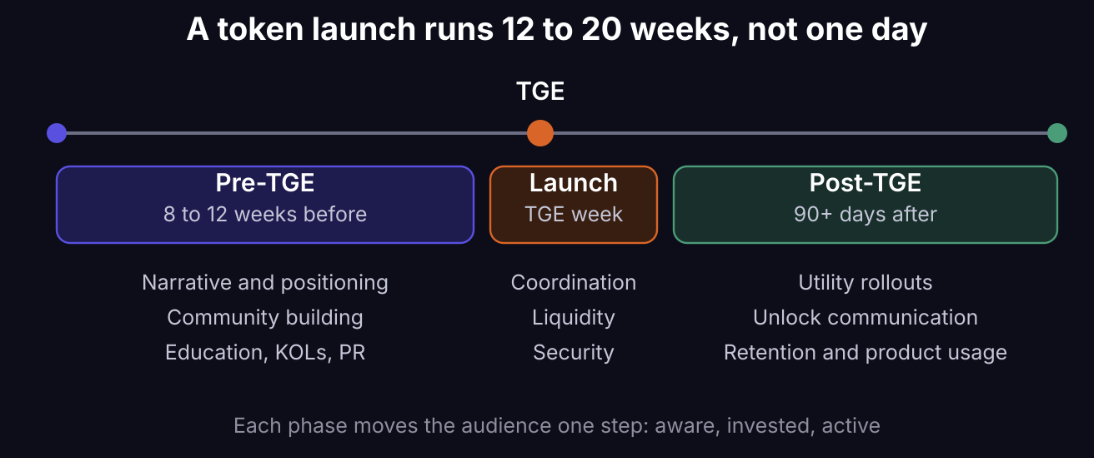
A complete token launch strategy spans roughly 12 to 20 weeks from first activity to the end of the post-launch window. That breaks into three phases: 8 to 12 weeks of pre-launch work, a tightly coordinated launch window, and at least 90 days of ongoing marketing after the TGE.
When should token launch marketing start? Eight to twelve weeks before the token generation event is the practical minimum. Outlier Ventures, one of the most active Web3 accelerators, recommends an eight-week run-up as a baseline and advises starting community growth earlier than seems necessary. That's how long it takes to explain what the project does, attract the right audience, and give community members time to become invested before there's anything to buy.
A token generation event needs a structured roadmap that moves the audience through levels of engagement: unaware, then curious, then informed, then committed. Each of those steps takes time and none can be skipped, which is why the calendar matters as much as the creative. Before any of it begins, though, there are foundations that marketing can't fix later.
Get the Foundations Right First
Marketing amplifies what's already there. If the token has no purpose, more awareness only helps more people discover that.
Start with tokenomics. A well-planned tokenomics plan covers total supply and distribution strategy: how much goes to the team, early investors, the community, and the treasury, and when each allocation unlocks. Buyers will read this closely, and so should whoever writes your messaging, because distribution is the first thing sceptics check.
Then comes token utility. The token needs a job inside the product, something that gives real users a reason to hold it beyond price. Utility is what your post-launch marketing will lean on, so if it isn't clear now, it won't be clear in week six.
Trust signals come next. Audited smart contracts, a public team, and clear documentation matter more in the crypto industry than polished branding, because launch effectiveness relies on the clarity of the messaging and the trust signals behind it. Our guide on how to position a crypto project covers how to turn those facts into a narrative people remember.
Finally, write it all down. A launch plan with owners, dates, and budget lines turns good intentions into a schedule; the crypto marketing plan template gives you a structure to fill in. With the foundations in place, the pre-launch work can begin.
Phase One: The Pre-Launch Phase
The pre launch phase is where a successful token launch is won. By launch day, most of the outcome has already been decided by what happened in the preceding weeks.
Build the community before the token
Projects should start community building 8 to 12 weeks before launch, and the aim is quality over size. A few hundred people who understand the project are worth more than a follower count in the tens of thousands, because engaged community members become advocates after launch while passive followers disappear.
Active Telegram and Discord communities are the centre of pre-launch community engagement. Regular AMAs turn attention into an active community by letting people ask hard questions and get straight answers. Quests and contributor programmes reward participation, giving early adopters something to do besides wait. And community channels must be moderated from the first day, since spam and phishing arrive as soon as a project gains visibility. Our guide on how to manage a crypto community goes deeper on the day-to-day.
Airdrops can speed up community growth, but only when they reward real participation. Done carelessly they attract farmers who sell at the first opportunity; done well they put tokens in the hands of people who already use the product. We cover the mechanics in our guide to airdrops and crypto bounty programs.
Educate in plain language
Community education increases long-term support, and it's the most neglected part of pre-launch marketing. Explain what the token does, how the tokenomics work, and what happens on launch day, in plain language, without assuming the reader has a technical background.
This content does double duty. It answers the questions your community is asking now, and it gives search engines and AI assistants something accurate to surface when new people look the project up later. A handful of clear explainers published early will keep working long after launch; our crypto SEO guide explains how to make sure they get found.
Line up KOLs, PR, and partners
Reach matters, but the source matters more. Strategic KOL partnerships should favour creators who understand your niche over those with the broadest audience, since an informed explanation to 20,000 relevant people beats a generic shoutout to a million. Our piece on why most crypto KOL campaigns fail covers how to vet and brief them.
Targeted PR builds public trust in a way paid promotion can't. Press releases and earned coverage give investors and users a third-party reference point, which is why blockchain PR belongs in the plan from the start. Partners help too: integrations and co-marketing with established projects open new markets and lend credibility you haven't had time to earn alone.
If the token is launching through a launchpad or an IDO, that channel needs its own marketing track. See our guides to crypto launchpad platforms and how to market an IDO for the specifics.
Why two weeks isn't enough

Projects that start marketing two weeks before TGE often fail, and the reason is simple. Two weeks is enough to generate noise, not enough to build understanding. The audience that shows up is there for the launch, not the project, and it leaves when the launch is over.
Building anticipation without overspending is a skill in itself; our guide to pre-TGE marketing hype shows how to pace it. Pacing leads directly to the next question every founder asks: how much to spend, and when.
How to Budget a Token Launch
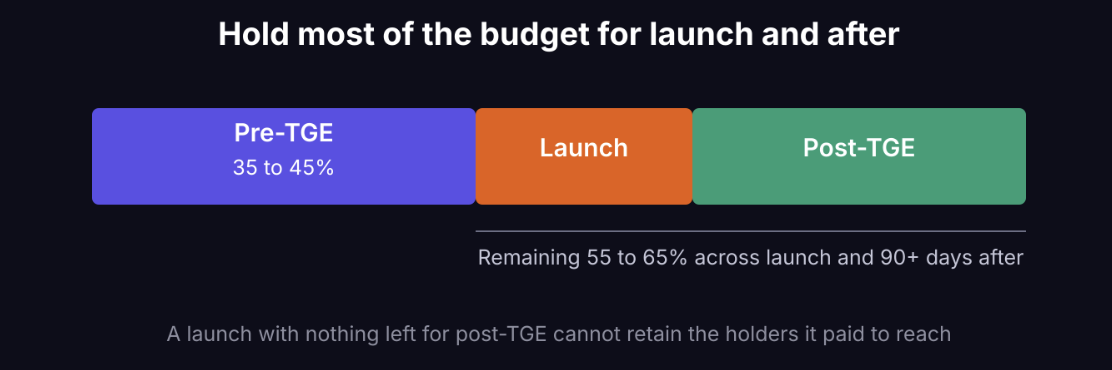
The most common budgeting mistake is front-loading. Teams spend heavily on the build-up, hit launch day with an empty account, and have no way to support the token when it needs it most.
A more durable split, and the one we recommend, is to allocate 35 to 45% of the budget before TGE and hold the remainder for launch and the months after. The pre-launch share funds community, content, KOL preparation, and PR. The rest covers launch-week amplification and, critically, the post TGE period, when ongoing marketing keeps new holders engaged.
Hold some back for future campaigns as well. The first 90 days will show you which channels bring in real users, and you'll want funds available to double down on them. With budget and groundwork in place, everything converges on a single day.
Phase Two: Launch Day
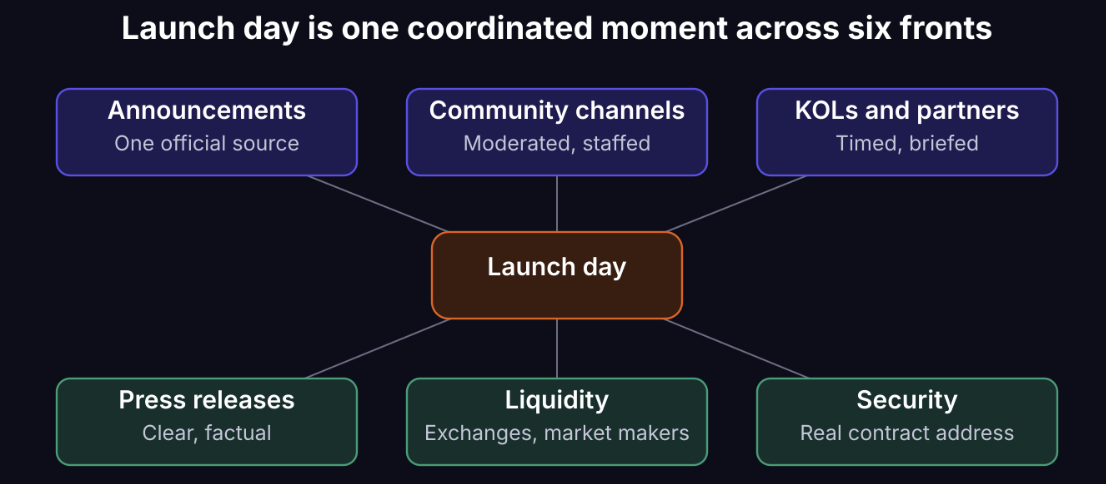
Launch day requires tight coordination across multiple channels. Announcements, community updates, KOL posts, press releases, and exchange activity all need to land in a planned order, and everyone involved needs to know that order in advance.
Coordinate every channel
Write a run-of-show: who posts what, where, and when, hour by hour. Publish from one official source first, then let community channels, partners, and KOLs amplify it. Staff Discord and Telegram heavily, because questions arrive fastest in the first hours and unanswered questions turn into rumours.
Keep the messaging factual. Say what's live, where to trade, and what comes next. Avoid price talk and financial predictions entirely; they create regulatory risk and set expectations you don't control.
Liquidity, exchanges, and market makers
Marketing can bring buyers to the door, but the trading experience decides whether they stay. Sufficient liquidity at launch keeps price volatility within a range that doesn't scare off new holders, whether the token lists on a decentralized exchange, a centralised crypto exchange, or both. Market makers help keep order books healthy and trading volume consistent through the first weeks.
Listings are also a marketing event in their own right, and each one deserves its own announcement plan. Our guide to crypto exchange listing marketing covers how to get the most from them.
Protect the community from scams
Scammers target every token launch with fake contract addresses, fake airdrop claims, and impersonated admins. This is a marketing problem as much as a security one, because a community member who loses funds on launch day blames the project.
Publish the real contract address in a pinned, official location before launch and repeat it everywhere. Tell the community plainly that admins will never message first. Brief moderators to remove fakes quickly. Our article on Telegram crypto scams lists the schemes to watch for. Once the token is trading and the community is safe, the real work begins.
Phase Three: Post-TGE Marketing
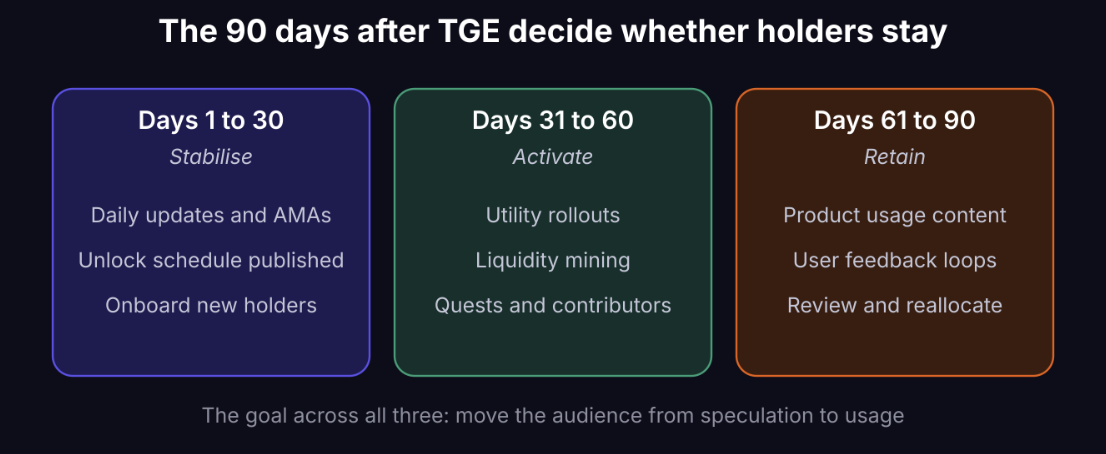
Many tokens lose momentum after launch because of poor planning, and this phase is where that shows. Post-launch marketing should continue for at least 90 days after TGE, and it has a different goal from everything before it.
Move the audience from speculation to product usage
At launch, most holders are there for the price. Effective crypto marketing transitions that audience from speculation to product usage, since active users are the only durable source of token demand.
That means post-launch strategies should plan utility rollouts and, where it fits the model, liquidity mining. Each new use for the token gives you something concrete to announce and gives holders a reason to do more than watch the chart. Tutorials, walkthroughs, and usage campaigns do the converting. The path from holder to active user is a funnel like any other; our crypto marketing funnel guide shows how to map it and find where people drop off, and our guide to getting the first 1,000 users covers early user acquisition.
Get unlock communication right
Nothing damages a new token faster than a surprise. To avoid panic selling, be transparent about token unlocks and airdrops: publish the schedule early, remind the community before each event, and explain what's unlocking and for whom.
Good unlock communication is how you maintain trust when the price is under pressure. Holders can accept dilution they understood in advance. What they don't forgive is finding out afterwards.
Keep talking and keep listening
Regular AMAs and updates strengthen communication between the core team and token holders, and they matter most when news is slow. A team that goes quiet after launch looks like a team that has left.
Listen as much as you announce. Continuous user feedback is essential for iterating on token utility; the people using the product will tell you what's working and what's confusing. Teams that act on it visibly build the kind of loyalty that supports long term adoption. All of which raises the final question: how do you know any of this is working?
Measuring a Token Launch
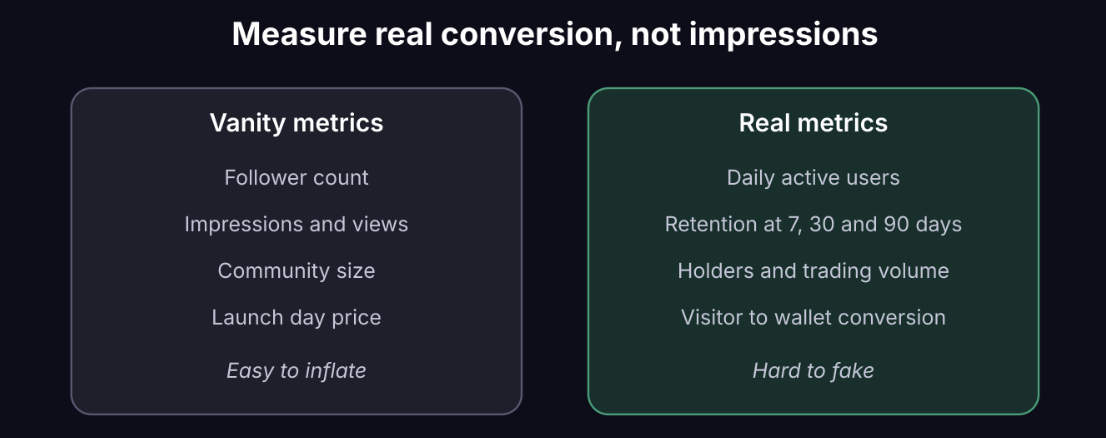
Measure success through real conversion metrics, not social media impressions. Follower count, views, and launch-day price are easy to inflate and say little about whether the project has a future.
The key performance indicators worth tracking are daily active users and retention rates, alongside holder count, trading volume, and the rate at which visitors become wallet holders and holders become product users. Check retention at 7, 30, and 90 days, since a launch that keeps its users at day 90 is in rare company.
Review these numbers on a fixed schedule and move budget toward what performs. If you want a model for how the pieces fit in practice, our breakdown of a successful token launch campaign walks through one from zero to 10,000 users.
Putting the Playbook Together
Launching a token well is a matter of sequence. Get the tokenomics, utility, and trust signals right. Start 8 to 12 weeks out and build a community that understands what it's buying. Budget so there's money left after launch day. Run the launch as one coordinated moment with liquidity and security handled. Then spend at least 90 days turning holders into users, communicating unlocks openly, and measuring what's real.
Most blockchain projects that fade after launch didn't fail on any single step. They compressed the timeline, spent everything upfront, and treated the TGE as the finish line. For crypto projects that plan the full arc, the launch is the beginning of adoption.
At GrowthChain, we plan and run token launch marketing from the first community post to day 90 and beyond, covering narrative, community, KOLs, PR, launch-day coordination, and post-TGE retention. If you have a launch date in mind, or you're still deciding on one, get in touch with our team and we'll help you build a launch that lasts longer than its first day.
Frequently Asked Questions
What is token launch marketing?
Token launch marketing is the planned sequence of marketing activity that takes a token from unknown to traded, held, and used. It covers the pre-launch phase, the token generation event, and at least 90 days of post-launch marketing, treated as one continuous programme.
When should token launch marketing start?
Start 8 to 12 weeks before the token generation event. That gives you time to explain the project, attract the right audience, and build a community that understands the token before it trades. Projects that start two weeks out often fail.
How long does a token launch campaign last?
A full campaign spans roughly 12 to 20 weeks: 8 to 12 weeks of pre-launch marketing, the launch window itself, and at least 90 days of post-TGE marketing.
How should a token launch budget be split?
Allocate around 35 to 45% of the budget before TGE and hold the rest for launch week and the post-launch period. Spending everything on the build-up leaves nothing to retain holders once the token is live.
Why do most token launches fail?
The common causes are starting marketing too late, relying on hype with no token utility behind it, and stopping all marketing on launch day. In 2025, 84.7% of 118 tracked launches traded below their TGE valuation, with the median token down 71% on fully diluted valuation.
What should you do after a token launches?
Continue marketing for at least 90 days. Roll out token utility, communicate unlocks and airdrops transparently, run regular AMAs, gather user feedback, and focus on moving holders from speculation to product usage.
What metrics matter for a token launch?
Track daily active users, retention rates at 7, 30, and 90 days, holder count, trading volume, and conversion from visitor to wallet holder to product user. Follower counts and impressions are weak indicators on their own.

From The Blog
You may also like


Stop Guessing. Start Scaling.
Data-driven crypto marketing that actually delivers users, not vanity metrics.

GrowthChain is a disruptive web3 marketing agency looking to propel your customer base. We focus on DAOs, DeFi, NFT and Crypto projects.

GrowthChain Designed, 2025
