





Most crypto projects can point to a moment where the numbers looked great. A viral tweet, a spike in Discord members, thousands of new followers overnight. And then, a week later, almost none of it turned into actual users. The awareness was real. The conversion never happened.
That gap is what a crypto marketing funnel exists to close. It's the structured path that moves someone from never having heard of your project to being an active, retained participant in it. Without a structured funnel, marketing efforts produce noise: attention that spikes and disappears, ad spend that generates clicks but no wallet connections, vanity metrics that look impressive and mean nothing.
This guide breaks down the crypto funnel stage by stage, explains how it differs from a traditional marketing funnel, and shows how to move users from first touch to long-term value. It builds on the channel-level thinking in our ultimate crypto marketing strategy guide; where that covers which channels to use, this covers how those channels connect into a single conversion path.
What Is a Crypto Marketing Funnel?
A crypto marketing funnel maps the user journey to on-chain actions. It's the sequence of stages a person passes through, from first becoming aware of your project to taking meaningful actions like connecting a wallet, making a first transaction, and eventually advocating for the project to others.
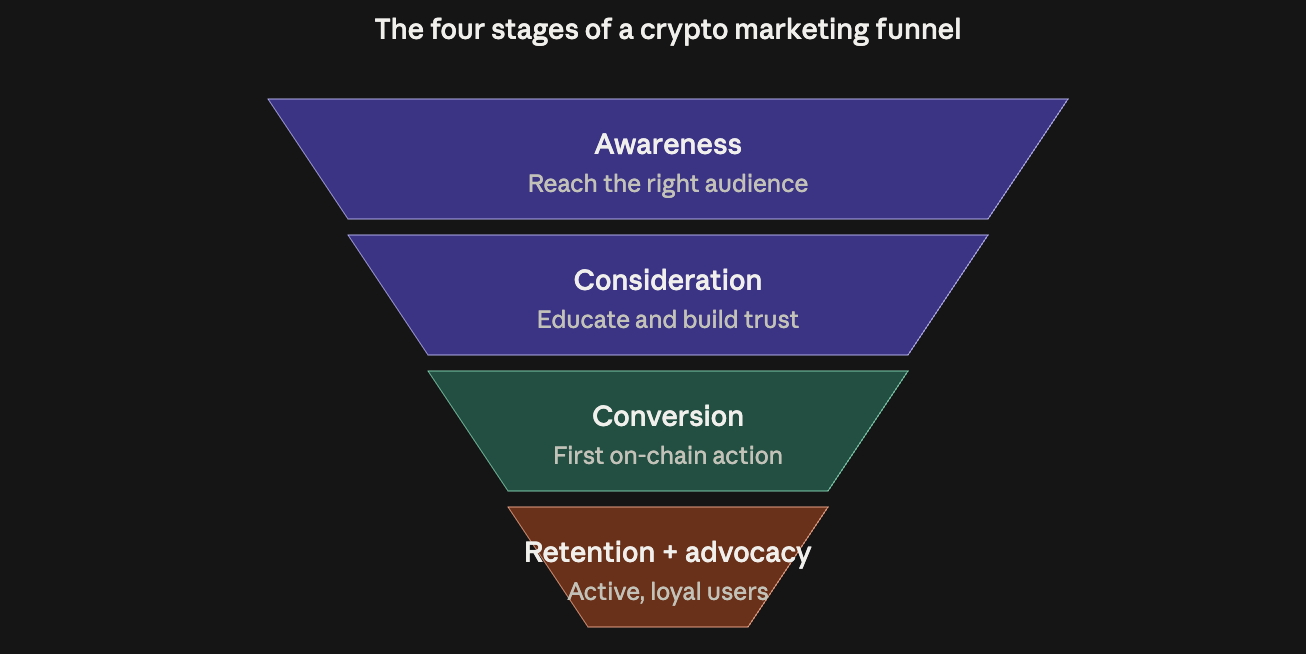
The funnel has four core stages: awareness, consideration, conversion, and retention and advocacy. Awareness is the top of the funnel, where people first encounter your project. Consideration is where education turns casual visitors into serious prospects. Conversion is where users take their first on-chain action. And retention ensures those users remain active participants in the ecosystem, with the best of them becoming advocates who feed new people back into the top of the funnel.
The word "funnel" implies users drop at every stage, and they do. Not everyone who becomes aware will consider, not everyone who considers will convert, and not everyone who converts will stay. The goal isn't to eliminate that drop-off, which is impossible, but to understand where it happens and reduce it at each step.
How a Crypto Funnel Differs From a Traditional One
Anyone who has built a web2 marketing funnel will recognise the shape but not the mechanics. The crypto funnel differs in ways that matter enormously in practice.
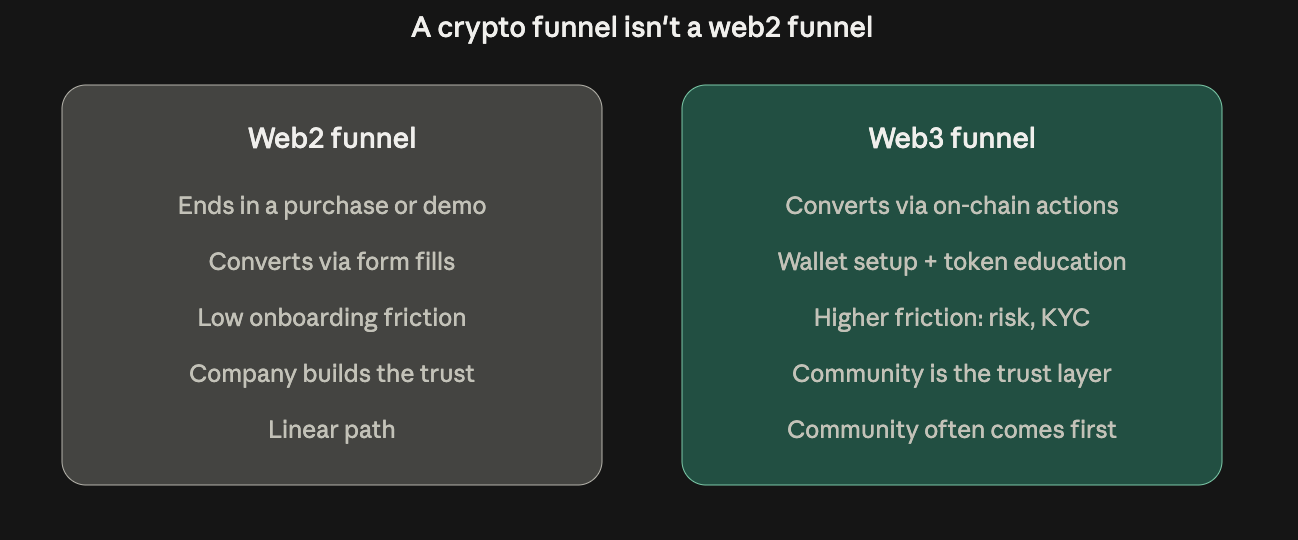
Web2 funnels typically end with a product purchase or a demo request. The path is relatively linear, onboarding friction is low, and the company is the entity that builds trust with the customer. Web3 funnels work differently. They convert through on-chain actions, not just purchases, which means the conversion event is a wallet connection or a first transaction rather than a checkout. They require wallet setup and token education before a user can even participate, and they face higher friction due to market risk and KYC checks.
The biggest structural difference is where trust comes from. In web3, community is the trust layer. Community-driven trust is essential in crypto marketing because regulatory constraints limit what projects can claim directly, so the community carries a credibility the brand can't manufacture alone. This is why users often enter community phases before any financial conversion, and why the crypto marketing funnel relies so heavily on community channels like Discord and X. A user might lurk in your Discord for weeks, absorbing whether the project is real, before they ever connect a wallet.
Web3 users also expect public proof. They want to see token utility demonstrated and smart contract audits published. A funnel that hides this information stalls; one that surfaces it openly moves people forward.
Stage 1: Awareness
The awareness stage is the top of the funnel, where potential users first encounter your project. The key challenge here is reaching the right audience rather than the largest one.
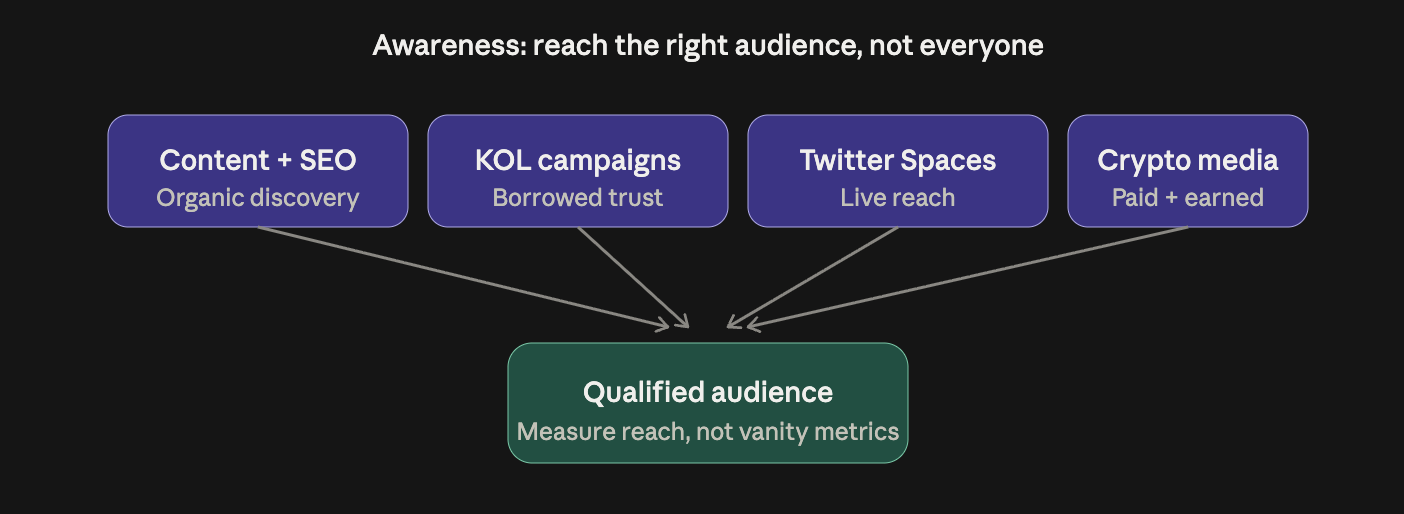
Effective strategies for awareness include influencer partnerships and educational content. KOL campaigns borrow the trust an established voice has already built with your target audience. Content marketing and SEO content create organic discovery paths that keep working long after publication. Twitter Spaces and live sessions put the team in front of an engaged audience in real time. Engaging with crypto media and KOLs extends reach into communities you couldn't reach directly.
The mistake most crypto projects make at this stage is measuring the wrong thing. Follower counts and impressions feel like progress, but they're vanity metrics if the audience isn't the right one. Measure reach against relevance. Ten thousand impressions from your actual target audience are worth more than a hundred thousand from people who will never connect a wallet. The point of awareness isn't volume; it's putting the project in front of the people most likely to move through the rest of the funnel.
Stage 2: Consideration
Once someone is aware of your project, the consideration stage is where they decide whether it's worth their attention. This is where education turns casual visitors into serious prospects and converts qualified interest into warm leads.
The interest stage is won or lost on trust and clarity. Clear documentation and AMAs help build trust here, giving prospects the information they need to take the project seriously. Technical content answers the questions that sophisticated users ask before they commit. Honest updates, including about what isn't working yet, build the kind of credibility that polished marketing can't.
This is also where the community does its heaviest lifting. A strong community has trained moderators and clear rules, and real discussions with fast answers build the trust that moves someone from curious to convinced. When a prospect asks a question in Discord and gets a genuine, fast answer from an active community, that single interaction often does more than any ad ever could. Active community members convert better than silent followers, so the goal at this stage is to turn passive observers into participants who feel some initial engagement with the project.
Stage 3: Conversion
Conversion occurs when users take their first on-chain action. This is the stage crypto funnels are ultimately built around, and it's where the highest friction lives.
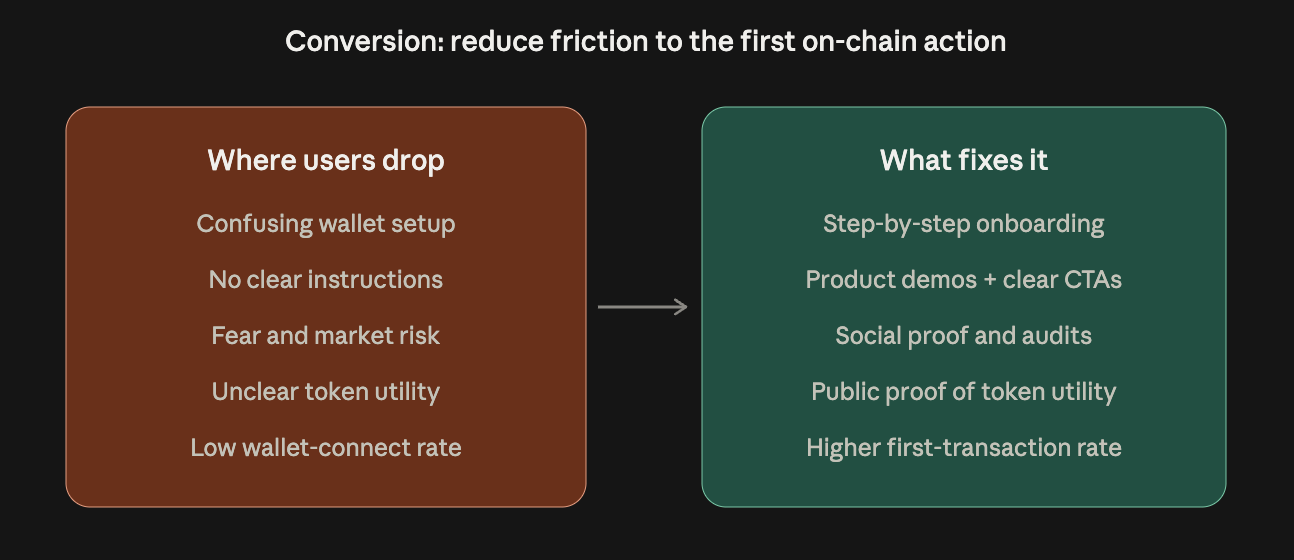
The conversion stage is where a high converting crypto funnel separates from a leaky one. Reducing friction in onboarding increases user conversion success, and in crypto there's a lot of friction to reduce. Confusing wallet setup, unclear instructions, fear driven by market risk, and vague token utility all cause users to drop right at the moment they were ready to act. Low wallet connection rates almost always indicate poor onboarding or user fear, not lack of interest.
The fixes are concrete. A step-by-step onboarding process with clear instructions removes the confusion. Product demos show rather than tell. Clear calls to action can significantly improve conversion rates, so every step should make the next action obvious. Social proof and published audits address the fear directly, giving users public proof that the project is legitimate. And clearly demonstrated token utility answers the question every user is really asking: why should I do this?
The metric that matters most here is the wallet-connect rate, followed by the first-transaction rate. These tell you whether your funnel is actually converting interest into on-chain activity or just accumulating people who look but never act. For projects preparing to launch, our crypto go-to-market strategy guide covers how to build the distribution that feeds this stage before you go live.
Stage 4: Retention and Advocacy
Conversion is not the finish line. A user who connects a wallet once and never returns hasn't been converted in any meaningful sense. Retention ensures users remain active participants, and it's where long-term value is actually created.
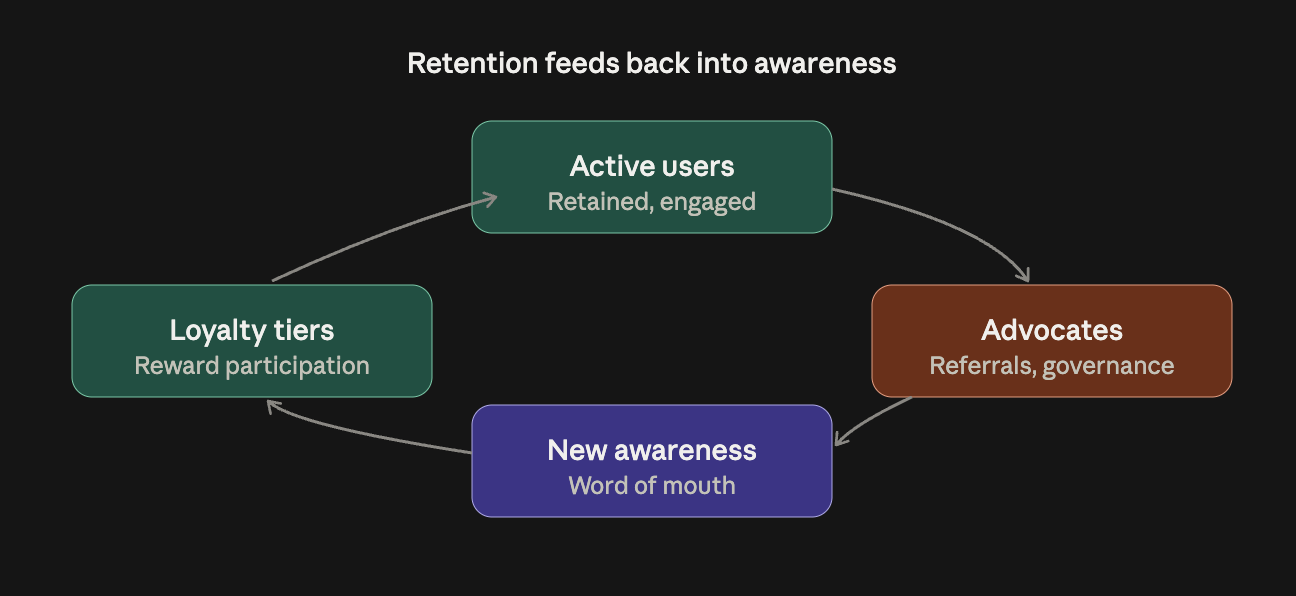
Retention strategies in crypto often look different from web2 retention. They may involve governance participation and community engagement initiatives that give users a genuine stake in the project's direction. Loyalty tiers reward continued participation. Ongoing education about new features, whether that's a new DeFi protocol integration or yield farming opportunities, keeps active users engaged and finding more value over time.
The most valuable outcome of retention is advocacy. Referral programs can help turn users into advocates, and happy users who refer others become a distribution channel in their own right. This is what closes the loop: retained users become advocates, advocates generate new awareness through word of mouth, and that awareness feeds the top of the funnel again. A funnel with a strong advocacy stage stops being a straight line and becomes a growth engine that partly fuels itself.
Measuring Funnel Success
A funnel you can't measure is a funnel you can't improve. The discipline that separates measurable growth from guesswork is tracking a real metric at every stage.
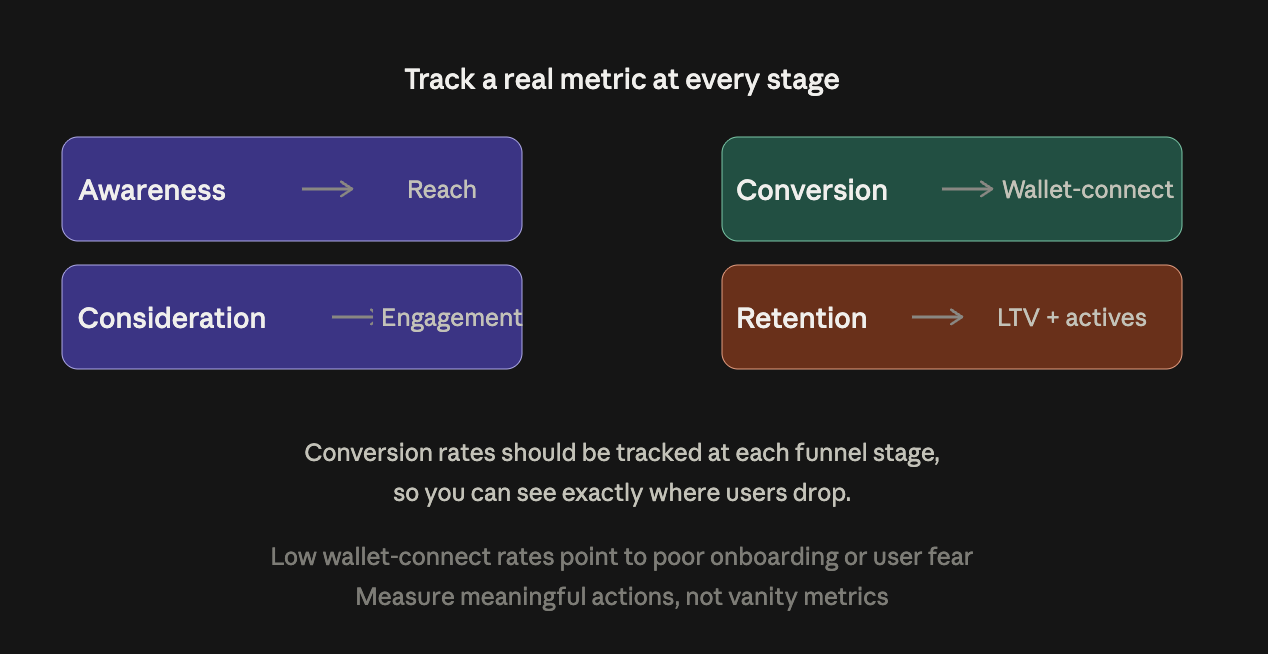
Conversion rates should be tracked at each funnel stage so you can see exactly where users drop. Awareness is measured by reach among the right audience. Consideration is measured by engagement and community participation. Conversion is measured by wallet-connect rate and first-transaction rate. Retention is measured by active participants, wallet activity over time, and customer lifetime value.
On-chain analytics give crypto marketers better data than any web2 funnel ever had access to. You can see wallet behavior directly: who connected, who transacted, who came back. Combine that on-chain view with traditional funnel metrics and you get a complete picture of where your marketing is working and where it's leaking. The projects that track this way can fix the specific stage that's underperforming instead of throwing more ad spend at the top and hoping.
Building a Funnel That Actually Converts
The crypto marketing funnel isn't a diagram to admire; it's a working system to build and refine. Awareness reaches the right audience, consideration educates and builds trust, conversion reduces friction to the first on-chain action, and retention turns users into active participants and advocates. Each stage feeds the next, and community runs through all of them as the trust layer that makes the whole thing work.
The projects that grow sustainably are rarely the ones with the loudest launch. They're the ones that built a structured funnel, measured where users dropped, and fixed it stage by stage. That's how spikes of attention become active users, and how active users become long-term value.
Building a funnel that converts takes more than knowing the stages; it takes matching the right channels, content, and onboarding to each one. At GrowthChain, we help crypto projects design and optimise marketing funnels that turn awareness into wallet connections and one-time users into loyal advocates. If you want a funnel built on what actually converts, get in touch with our team and let's map yours together.
Frequently Asked Questions
What is a crypto marketing funnel?
A crypto marketing funnel is the structured path that maps a user's journey to on-chain actions, moving them from awareness through consideration and conversion to retention and advocacy. It's how crypto projects turn attention into active, retained users.
What are the stages of a crypto marketing funnel?
The four core stages are awareness, consideration, conversion, and retention and advocacy. Awareness reaches the right audience, consideration educates and builds trust, conversion drives the first on-chain action, and retention keeps users active while turning the best of them into advocates.
How is a crypto funnel different from a traditional funnel?
A traditional web2 funnel usually ends in a purchase or demo request and is relatively low-friction. A crypto funnel converts through on-chain actions like wallet connections, requires wallet setup and token education, faces higher friction from market risk and KYC, and relies on community as its trust layer.
Why do users drop out of a crypto funnel?
Users most often drop at the conversion stage due to confusing wallet setup, unclear instructions, fear driven by market risk, or unclear token utility. Low wallet-connection rates usually signal poor onboarding rather than lack of interest.
What metrics should I track in a crypto marketing funnel?
Track a metric at every stage: reach for awareness, engagement for consideration, wallet-connect rate and first-transaction rate for conversion, and active participants plus customer lifetime value for retention. On-chain analytics let you measure real wallet behavior rather than vanity metrics.
How do I improve conversion in a crypto funnel?
Reduce onboarding friction with clear step-by-step instructions, use product demos and clear calls to action, publish audits and social proof to address user fear, and demonstrate token utility openly. Each of these directly lifts the wallet-connect and first-transaction rates.

From The Blog
You may also like


Stop Guessing. Start Scaling.
Data-driven crypto marketing that actually delivers users, not vanity metrics.

GrowthChain is a disruptive web3 marketing agency looking to propel your customer base. We focus on DAOs, DeFi, NFT and Crypto projects.

GrowthChain Designed, 2025
.svg)